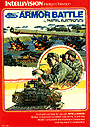
 Armor Battle
Game Factory (unreleased)
Melody Maker (unreleased)
Music Conductor (unreleased)
Sailing (unreleased)
Super NASL Soccer (unreleased)
Winter Olympics (unreleased)
The Action and Space Action Networks featured arcade-style games. The Intellivision was introduced with the promise of a well-rounded library, but by late-1982 it became obvious that, responding to market demand, most of the new games then in development would wind up in the Action Network. Rather than continuing to point out the growing disparity between the Action and the, say, Children's Learning games (two titles and holding), Marketing quietly discontinued the network concept.
All of the games on this page were released in Action Network red boxes, with the exception of Pinball. While Pinball had long been listed as an Action Network game, it was released in 1983 after the networks had been abandoned. Several of these games were also released under the Sears brand name in different packaging.
Armor BattleINTELLIVISION CARTRIDGE [#1121]
Also released by Sears [#4975211]
Working title: Tanks-A-Lot
Produced by APh Technological Consulting for Mattel Electronics
Program: Chris Kingsley
 CATALOG DESCRIPTION
Dust off your field glasses and scan the horizon for enemy tanks. There's one -- grinding its way out of the woods!
You see each other at the same time. Both turrets swing toward their targets. Who will fire a split second sooner? And who will be reduced to a pile of rubble?
When you've beaten your opponent, move on to a new battlefield. There are literally hundreds of new terrains to conquer!
War may be nerve-wracking, but this is pure fun!
PRODUCTION NOTE
An M Network version of the game, called
Armor Ambush, was released for the Atari 2600.
 FUN FACT: The game actually made it pretty far through the production phase with the title "Tanks-A-Lot" before some Mattel bigwigs pronounced the name "stupid" and made APh change it. David Rolfe (Major League Baseball) avers, however, that the name wasn't APh's idea - it had been attached to the original concept art that came from Mattel.
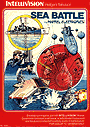 Sea Battle
INTELLIVISION CARTRIDGE [#1818]
Also released by Sears [#4975213]
Produced by APh Technological Consulting for Mattel Electronics
Program: Ken Smith
 CATALOG DESCRIPTION
Destroyers, battleships, submarines, minesweepers, and aircraft carriers! You're the Admiral, and your mission is to rid the seas of the enemy fleet.
Start by setting a strategy. Lay invisible minefields where you think the big enemy ships will travel. But be careful, because the other Admiral is laying mines to foil you...
Battle stations! Now you slug it out with shells, torpedoes, and naval tactics. Sleek battleships are waiting to pounce on sluggish minesweepers. You can't relax for a minute.
But who worries about the torpedoes, you say. Full speed ahead!
PRODUCTION NOTE
An M Network version of the game - called
Sea Battle in some catalogs,
High Seas in others - was announced for the Atari 2600 and completed, but never released. An Aquarius version was also announced, but never completed.
 Space Battle
INTELLIVISION CARTRIDGE [#2612]
Working title: Battlestar Gallactica
Produced by APh Technological Consulting for Mattel Electronics
Program: Hal Finney
 CATALOG DESCRIPTION
Outer space action! You must outwit the computer-controlled invaders! Consult the situation map, deploy the defense. Switch to cockpit close-up. Fire lasers! Save the command ship! You do it all, amidst the simulated sounds of outer space combat.
DEVELOPMENT HISTORY
If the enemy spacecraft look familiar, it's because they are Cylon raiders from the late-seventies TV program Battlestar Gallactica. One of Mattel's subsidiaries, Concepts 2000, had the license to produce Battlestar Galactica electronic toys, so it was figured to be a lock that Mattel would get the license to produce the official Battlestar Gallactica videogame. Wrong. The game was well into development when they discovered Mattel didn't get the license. The name was changed, but the graphics remained the same.
An M Network version of the game, called Space Attack, was released for the Atari 2600.
 RUNNING CHANGE: When the game was finished, Dale Lynn, who tested it, said it was too easy. APh cranked up the difficulty, but Dale told them it was still too easy. "Maybe for you," he was told, "but not for the general public." Wrong again. Consumers found the game too easy when it was released.
A more difficult version was released soon after as part of the new Space Action Network. This version, in a blue box with a blue label, is the more familiar.
 Sub Hunt
INTELLIVISION CARTRIDGE [#3408]
Working title: Submarine, Submarine Battle
Produced by APh Technological Consulting for Mattel Electronics
Program: Tom Loughry
 CATALOG DESCRIPTION
You're at the periscope of a Nautilus class nuclear submarine, the last line of defense between the enemy and the fleet. Enemy PT boats drone around seeking you out. Meanwhile, enemy destroyers constantly jockey for depth-bombing position. You must keep you head to control depth, speed, direction and torpedoes. You have simultaneous periscope and satellite horizon displays with compass readings to keep you afloat and the enemy at bay. If you do it, you should be immediately commissioned an Admiral in the U.S. Navy.
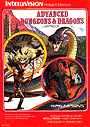 ADVANCED DUNGEONS & DRAGONS CLOUDY MOUNTAIN Cartridge
INTELLIVISION CARTRIDGE [#3410]
AKA Adventure (working title), Dungeons & Dragons, D&D, ADVANCED DUNGEONS & DRAGONS Cartridge
Based on the role-playing game by TSR Hobbies, Inc.
Produced by APh Technological Consulting for Mattel Electronics
Program: Tom Loughry
 CATALOG DESCRIPTION
Take the wrong turn and you'll soon be staring at the biggest, meanest and most clever dragon you've ever imagined. You start out in a maze. But, this is no ordinary maze. It's revealed to you only a few feet at a time as you enter each new uncharted corridor. The maze scrolls: up, down, right and left. You don't know when it's going to take a turn -- for the worse. That dangerous dragon could be between you and the treasure that you must find. Along your way you'll find a variety of objects to help you avoid the dragon. Based on the popular role-playing board game, this video version will provide you with many hours of enjoyment.
PRODUCTION HISTORY
Because of its complexity, this was the first cartridge to go over the 4K size limit; it was allocated a whopping 6K.
Originally released as ADVANCED DUNGEONS & DRAGONS Cartridge, CLOUDY MOUNTAIN was added to the name later when ADVANCED DUNGEONS & DRAGONS TREASURE OF TARMIN Cartridge was announced.
FUN FACT: The all-capitalization and the word "cartridge" are actually part of the title, as required by the contract with TSR Hobbies, owners of the Dungeons & Dragons trademark.
INTELLIVISION CARTRIDGE [unfinished]
AKA Zork
Produced by APh Technological Consulting for Mattel Electronics
PRODUCTION HISTORY
As indicated by its working title, this game was inspired by the text adventure game Zork. It didn't get too far; about the only record of it is in a December 10, 1981 status report written by Gabriel Baum, VP of Applications Software, after reviewing development at APh: "A new game closely paralleling Dungeons & Dragons. A man in a large cave searches for treasure, is attacked by beasts and defends himself or proceeds within the game using objects he collects. Currently only some graphics are defined." The game apparently was discontinued because it was too similar to the two Dungeons & Dragons cartridges already in development.
 Snafu
SnafuINTELLIVISION CARTRIDGE [#3758]
Working titles: Blockade+Snakes, Ssssnakes!
Program, Graphics and Sound: Mike Minkoff
Music: Russ Lieblich
 CATALOG DESCRIPTION
You each start off with little lines that start to grow.
They grow fast, tangling, weaving, writhing like magic beanstalks. And you're at the controls, trying to completely enclose the other guy so he can't grow any more.
This is a game of lightning quick strategic decisions. Hesitate...or slip...and you'll find yourself surrounded.
PRODUCTION HISTORY
Developed under the working title Blockade+Snakes to reflect the two basic versions of the game. In the first, inspired by the board game Blockade, opponents try to surround and trap each other. In the second, inspired by a handheld LED game in development at Mattel but never released, opponents bite at each other's tails until one is reduced to nothing.
Mike liked the name Ssssnakes! and started using it on the title screen; he fought for it to be the final name. Marketing instead chose Snafu, from the military acronym "Situation Normal -- All Fouled Up" (actually, most veterans use a different word than "Fouled"). Mike hated the name since it had nothing to do with the gameplay.
Snafu was the only game released to use the Intellivision video chip's colored squares mode.
An Aquarius version of Snafu was also released.
 PLAYING TIPS: From Intellivision Game Club News, Issue 2, Winter 1982 (credited to "Mike, another Intellivision programming specialist"):
 Triple Action
INTELLIVISION CARTRIDGE [#3760]
Working titles: Some of Theirs, 5-in-1 Arcade, 3-in-1 Arcade
Produced by APh Technological Consulting for Mattel Electronics
Design/Program: Rich O'Keefe
 CATALOG DESCRIPTION
It's three classic video games in one!
Racing Cars -- You and your opponent race against the clock down a crowded highway.
Battle Tanks -- It's a duel to the finish between two heavy tanks. One of you will end up as scrap iron.
Biplanes -- It's a thrilling dogfight -- biplane style! Watch out for the control tower...don't get lost in the clouds. But most of all, watch out for that blood thirsty baron with a leather cap!
PRODUCTION HISTORY
This started out to be a collection of six games "inspired" by Atari 2600 cartridges, hence the APh working title, Some of Theirs. Space considerations forced this to be dropped to five: a tank battle, a car race, a dogfight, a Breakout-like game and a Pong-like game. Within Mattel Electronics, the cartridge was known as 5-in-1 Arcade.
Shortly before completion, Mattel's lawyers stepped in and decided that some of Some of Theirs was TOO MUCH like some of theirs. To avoid a lawsuit from Atari, the lawyers asked that Brickout!, the Breakout-like game, and Hockey, the Pong-like game, be dropped from the cartridge. The game was renamed 3-in-1 Arcade and, finally, Triple Action.
A sequel, More of Theirs, was started by Rich O'Keefe but never completed.
FUN FACT: More hours were spent in the programming cubicles playing Biplanes than any other Intellivision game. Although it's one of the simplest, many programmers felt it was the most challenging and fun of the two-person games. The first time you deliberately stall, go into a free fall, then pull out with a backward loop at the last second to blast your opponent at pointblank range is a joy!
FUN FACT: So many hours were wasted on Biplanes, that when a memo was circulated April 1, 1982, ordering Triple Action deleted from programmers' hard disks, Biplanes-addict Steve Montero (Night Stalker) didn't argue; sheepishly, he erased it, only later discovering that the memo was an April Fool's hoax.
FUN FACT: In Biplanes, although the game ends when one player reaches 15 points, bullets in the air at that point are allowed to score. It's possible, therefore, to have a game with a 15-15 tie, or to win with 16 points.
FUN FACT: Brickout! was another early programmer favorite. Although cut from Triple Action, the game was available for downloading on a programmer's development system and led to a one-person waste of time when an opponent for Biplanes wasn't available.
INTELLIVISION CARTRIDGE [UNRELEASED]
Produced by APh Technological Consulting for Mattel Electronics
Design/Program: Rich O'Keefe
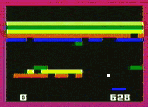 GAME DESCRIPTION
Use your paddle to bounce a ball against descending rows of colored bricks. Hit bricks disappear, scoring points.
PRODUCTION HISTORY
Brickout! was an Intellivision version of the Atari arcade and video game Breakout. It was intended for the Triple Action cartridge, which was originally to have included five arcade-type games. Brickout! was shelved for fear of legal action from Atari; such fears also killed the original version of Astrosmash, which was an Asteroids-like game.
The stand-alone version of the game was popular with the Mattel Electronics programmers. It finally had its commercial release on the Intellivision Lives! CD-ROM in December 1998.
 Frog Bog
INTELLIVISION CARTRIDGE [#5301]
Working title: Frogs
Produced by APh Technological Consulting for Mattel Electronics
Program: Peter Kaminski, Tom Soulanille
 CATALOG DESCRIPTION
Sitting upon two lily pads in the middle of a lily pond are a pair of hungry frogs; one for you, one for your opponent. Overhead swarm delicious flies. Whether or not your frog scores his dinner while you rack up points is entirely up to you. You control the height and direction of his jump; even the flick of his long pink tongue. Leap too high or at the wrong angle and "Pl-op" your frog goes into the pond. He must swim back to his lily pad, taking away valuable scoring time while your opponent goes on racking up points. As play continues, night will come to the pond. Or, you can choose to play the entire round at night, leaping for fireflies -- in the dark.
PRODUCTION NOTE
An M Network version, called
Frogs and Flies, was released for the Atari 2600.
INTELLIVISION CARTRIDGE [#5302/UNRELEASED]
Produced by APh Technological Consulting for Mattel Electronics
Program: Glyn Anderson
Revised Graphics: Peggi Decarli
 PROGRAMMER'S GAME DESCRIPTION
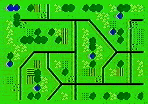
Land Battle is a two player war game which utilizes both strategic and tactical modes of play. Each player controls an array of forces with the objective of capturing or destroying his opponent's "flag."
The game can be played on any of thousands of different countryside maps -- the first thousand of which are selectable at the beginning of the game. All of these maps show roads, towns, hills, lakes, forests, orchards, and fields, and these geographic features impose restrictions and necessitate clever planning on the part of the player.
At the beginning of the game each player has control of the following military resources:
You can capture opposing forces which subsequently become yours.
In order to wage an effective war, you must allocate your resources into patrols, direct the patrols across the map, encounter enemy patrols, fight battles, besiege towns, and eventually capture or destroy the enemy flag.
PRODUCTION HISTORY
This wargame simulation took a long time in programming (officially 391 days, compared to 170 days for Night Stalker, begun at about the same time); when completed in mid-1982, Marketing was concerned that its design already looked dated.
A second concern was that, due to the complexity of the game, it required more memory than an Intellivision contained; the cartridge would have to include 256 bytes of RAM onboard. Only USCF Chess had been approved for onboard RAM, an expensive proposition.
When the Entertainment Computer System (ECS) was given the green light, Gabriel Baum, VP of Applications Software, proposed changing Land Battle to an ECS title; the ECS had an additional 2K of RAM available for cartridges. Marketing resisted this -- they still wanted Land Battle as a stand-alone game. Peggi Decarli was assigned to give the game a graphics makeover.
After the makeover, Marketing still didn't find it visually interesting enough. By that time, wargame fanatic Steve Sents, having completed Deadly Discs, had started work on an ECS wargame called Desert Fox, which Marketing liked the looks of better. The decision was made to kill Land Battle and incorporate as much of its gameplay and programming as possible into the Desert Fox design.
 Night Stalker
INTELLIVISION CARTRIDGE [#5305]
Working Title: Attacker
Design & Program: Steve Montero
Graphics: Peter Allen
Sound: Russ Lieblich
 CATALOG DESCRIPTION
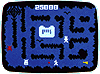
You're on the run. Your attackers are relentless robots. Destroy one and it's replaced by an even smarter, faster robot. It's a nightmare. Your only defenses are avoidance and weapons found somewhere in the labyrinth. When one weapon empties, you avoid robots to find another. Duck around a corner or go into your safe house. But, be careful. There are also people-size spiders and their webs to slow your escape. Bats also wing their way at you. If either spiders or bats bite you, you're stunned; easier prey for the robot attackers.
PRODUCTION HISTORY
Steve Montero is an expert on robotics, so it was natural for him to program Night Stalker. In development late in 1981, the game was a favorite with other programmers, who didn't need their arms twisted to spend hours testing it. Unfortunately, the first time Marketing brought in some 12-year-old kid to try it out, he got further than any of the programmers had. A new, tougher robot had to be added to the game, at the cost of losing one of the best features: the spider's web (the game was only 4K in size). Originally, as the spider crawled around the maze it left a web that would slow you down considerably as you ran through it. You could shoot the web away, but you'd use up bullets. Without the web, the spider became like the bats: just a nuisance.
After Night Stalker was finished, game cartridges began getting larger in size, so Steve proposed Ms. Night Stalker, a 12K sequel that would include the web and all the other features he had wanted, including multiple weapons (bazookas to blast through walls!), multiple scrolling mazes and smarter robots. Marketing shelved the idea and Steve was assigned to program Space Shuttle instead, which may have been a contributing factor toward Steve leaving Mattel and the game industry not long after.
Mattel Electronics released M Network versions of Night Stalker for the Atari 2600, the Apple II and the IBM PC. (The Atari 2600 version was called Dark Cavern.) A version was also released for the Aquarius Home Computer System.
 PLAYING TIPS: From Intellivision Game Club News, Issue 4, Winter 1983:
PLAYING TIPS: Night Stalker is a favorite of Blue Sky Ranger Steve Roney (Space Spartans, B-17 Bomber). He plays the game with a controller in each hand -- one to run, one to shoot -- since buttons and disk cannot be used simultaneously on one controller.
Steve adds: "Another trick to bagging the later robots has to do with there being only one moving object available for the robot bullets. If you wait just above the place where the robot appears and dangle your feet where the robot can see, the robot will shoot below your feet. You can then safely drop down and quickly get off all three shots to nail the robot before his bullet gets all the way across the bottom!!!!"
 FUN FACT: Russ Lieblich was proud of his sound effects for Night Stalker, especially the constant heartbeat. Whenever he heard someone playing the game, he'd run into their cubicle, grab the volume control on the TV, and turn it up full.
 Pinball
INTELLIVISION CARTRIDGE [#5356]
Design & Program: Minh Chou Tran, Bob Newstadt
Graphics: Peggi Decarli, Monique Lujan-Bakerink
Sound: Mark Urbaniec
 CATALOG DESCRIPTION
A challenging and exciting video version of the time-honored Pinball machine you find in arcades. You get it all -- five balls, flippers, two- player scores, with all the sounds and action of the real thing. If you've ever "tilted" a real pinball machine, try our Pinball. You're in for some surprises and a whale of a lot of fun.
PRODUCTION HISTORY
Pinball was in production longer than any other Intellivision game -- well over two years. Chou Tran, who started the game, could never get the ball motion debugged. Finally, Bob Newstadt was assigned to help her. He got the motion problems worked out, then he and Chou expanded the design from it's original single screen to its final multi-screen layout.
Although originally announced as part of the red-boxed Action Network, the game was released in 1983, after the "network" concept was dropped. Pinball was released in a purple box.
 TRON Deadly Discs
INTELLIVISION CARTRIDGE [#5391]
AKA TRON I, Deadly Discs
Based on the Walt Disney Productions motion picture TRON
Design & Program: Steve Sents
Graphics: Eric Wels
Sound: Bill Goodrich
 CATALOG DESCRIPTION
Our hero, TRON, is locked in battle against the Evil Blue Warriors. Score points by knocking out the computer-controlled attackers with flying discs. Your task is to bring your man safely through battle after battle. The attacking warriors are also armed with destroyer discs, and they'll come after TRON in wave after wave. You get them, or they'll get TRON!
PRODUCTION HISTORY
TRON Deadly Discs was in production at the same time as TRON, the Disney movie; the design for the game was based on storyboards and production stills from the film.
Mattel Electronics bet a lot of dough that the movie would be a phenomenon. A state-of-the-art special effect film about video games, the hottest trend in the country -- how could it miss? Well, it did. The lukewarm reception the movie received did little to boost interest in the six TRON games Mattel released (four originals, two conversions). TRON Deadly Discs, though, was a strong enough game in its own right to garner good reviews and word-of-mouth; it went on to sell over 300,000 copies -- a respectable number, but only about a third what Marketing was hoping for. Ironically, the original production run was planned to be 350,000, but at the last minute it was increased to 800,000. "The reason for the increase," explained Marketing man Dick Baumbusch in a June 1, 1982 memo, "is due to the anticipated popularity of the Tron film and the fact that we will feature it in a commercial this Fall. Also, the international demand for Tron will limit any downside risk." It was this type of forecasting that put Intellivision where it is today.
In answer to a frequent question, there was no connection between the production of Mattel's TRON video games and the arcade games TRON and Discs of TRON. A separate company had licensed the arcade rights to the movie and there was no communication between them and Mattel.
Early catalogs listed TRON Deadly Discs (under its working title TRON I) as a Space Action Network cartridge; it was actually released as part of the Action Network.
An M Network Atari 2600 version and an Aquarius version were also released.
 BUG: There is a trick that pretty much lets you rack up unlimited points, as first pointed out in a letter Mattel received November 3, 1982 from Steven M. Little, an Intellivision owner in Minneapolis: "Once you are able to open the top left and top right doors, which enables you to go in one door and out the other...just step out the right top or left top door and stay there...90% of the enemy discs go through you and your man is not hit or destroyed. If you stay at that position, you can reach a score of 1,000,000 very easily by just breaking the enemy's discs and...throwing your disc just enough to keep only one enemy on the board at all times. Once you reach close to a million points, don't destroy any more warriors. Just hold your disc in the block mode and break discs. If you do get hit just go back and forth for repair. (Never throw disc to destroy warrior for you may get a replacement that carries the stick.) I went from 1,000,000 to 10,000,000 with no problem."
PLAYING TIPS: From Intellivision Game Club News, Issue 5, Spring 1983:
PLAYING TIP: This is the favorite Intellivision game of Blue Sky Ranger David Warhol (Mind Strike). He plays with one controller in each hand -- one for maneuvering (thumb on disc), one for throwing (thumb on keypad). "If you like Deadly Discs with one hand controller, you'll love it with two," he says. "Try it now and thank me later."
 EASTER EGG: Deadly Discs fan Dave Warhol put together his own private version of the game, replacing the enemy warriors with the hot dogs from BurgerTime. He called the result Deadly Dogs. If you want to play it, it's hidden in the INTV Corporation release of Dig Dug: press 47 (4 and 7 simultaneously) on both hand controllers and press reset. The Deadly Dogs title screen will appear.
 TRON Maze-A-Tron
INTELLIVISION CARTRIDGE [#5392]
AKA TRON II, Mazatron, Maze-A-Tron
Based on the Walt Disney Productions motion picture TRON
Design & Program: Russ Haft
Graphics: Eric Wels
Sound: Andy Sells
 CATALOG DESCRIPTION
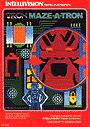
Based on the Disney movie TRON, this is a great action game for 1 or 2 players. You are engaged in a deadly struggle to penetrate the inner circle of the Master Control Program. Watch out for the deadly "bits." You've got to destroy them to reach your goal and accumulate the most points.
PRODUCTION HISTORY
Like TRON Deadly Discs, this game's production paralleled the production of the movie. And like TRON Deadly Discs, the movie's less-than-enthusiastic reception didn't help sales.
Note: Despite what the above early catalog description says, TRON Maze-A-Tron is a one-player game.
An M Network Atari 2600 version was developed, but the results were so different from the original that the release name was changed to Adventures of TRON.
 Lock 'N' Chase
INTELLIVISION CARTRIDGE [#5637]
Based on the Data East arcade game
Program: Mike Winans, Julie Hoshizaki
Graphics: Peggi Decarli
Sound: Bill Goodrich
 CATALOG DESCRIPTION
A fast-action chase game as you maneuver your thief through the maze, picking up coins and other treasures. Billy-club swinging cops are in hot pursuit, but you can temporarily escape them by locking gates behind you. The longer you survive, the more valuable the treasures become. One or two players.
PRODUCTION HISTORY
Lock 'N' Chase was the first in a series of conversions based on Data East arcade games, a series that eventually would include Bump 'N' Jump, BurgerTime, Mission X, Thin Ice (based on the arcade game Disco No. 1) and the unfinished PizzaTime (a BurgerTime sequel). The association carried over to INTV Corporation, which did Commando and Diner (another BurgerTime sequel).
Mike Winans almost killed himself trying to fit the game into 4K. He finally proclaimed it couldn't be done and, reluctantly, 6K was authorized. Mike managed to just squeeze it into the 6K, although the control of Lupin wasn't ideal. (In the arcade game, the thief is named Lupin, a nice touch of personality that Mattel left out of our version.)
When the game was released, press and customers complained about how difficult it was to control Lupin. (You had to time turns precisely, or Lupin would stop dead.) The problem was considered bad enough that a running change was ordered: after the 6K cartridges were sold out, improved 8K versions would be released. By this time, Mike had transferred to the Design & Development department, so Julie Hoshizaki was assigned to make the improvement. The improved versions aren't marked on the package; the easiest way to tell if you have an improved version is to watch what happens when a cop catches Lupin. In the arcade game, Lupin collapses into his hat -- an animation there wasn't room for in the 6K version. The collapsing animation is in the 8K version.
An M Network Atari 2600 version and an Apple II version were also released. IBM PC and Aquarius versions were announced, but never completed.
FUN FACT: In the arcade version, the thief is named Lupin, but not in the Mattel Electronics version. Why not? In the early 1900s, French author Maurice LeBlanc wrote a series of books featuring Arsene Lupin: Gentleman Thief. The books became popular in Japan, where they later inspired a series of comic books that were even more popular. The problem: the comic books were not authorized by LeBlanc. At the time, it was difficult enforcing a French copyright in Japan, so Lupin entered Japanese culture, eventually becoming synonymous with the word "thief." The copyright was enforced in the United States, though, where the Japanese Lupin comics developed a following. In English translations, the name Lupin is often changed to Rupin to avoid the copyright problem. For the game Lock 'N' Chase, Mattel avoided the copyright problem by leaving out the name altogether.
FUN FACT: An insignificant typo almost caused Mattel to dump tens of thousands of dollars of perfectly good ROMs and to delay the release of Lock 'N' Chase by several months. Why? First, some background:
The legal department required programmers to include an ASCII copyright notice somewhere in every game so that it could be read if someone dumped the cartridge's object code. Traditionally, if there was room, the programmer would also include his or her name. (It was forbidden to hide your name in the game such that it could ever show up on screen, but object code was OK.) For Lock 'N' Chase, Mike included his, Peggi's, and Bill's name in the code. The day the game was to be shipped to the ROM factory, the three of them went to lunch to celebrate. At lunch, Mike realized for the first time that Peggi's last name is spelled "Decarli." He had spelled it "de Carli" in the code. No problem; he went back after lunch, corrected it, then bid everyone farewell and went off to his new job in Design & Development.
What Mike didn't know was that Bill Fisher, who was in charge of coordinating with the factory, had copied the finished game off of Mike's hard disk during lunch and shipped it out.
Three months later, ten thousand plus ROMs were finished. Sample chips were sent back from the factory. Bill loaded one into a ROM reader, then compared the chip's checksum to the checksum of the archived version on Mike's hard disk. To Bill's horror, they didn't match. There was a bug in the ROMs!
Programmers started playing the game for hours on end, trying to see how bad the bug was -- would the game crash? Marketing needed to know instantly if the game was releasable. Should they toss out tens of thousands of dollars worth of chips and lose at least three months time, or should they risk the bad publicity of sending out a bug-filled version?
Finally, after a couple days of panic and anxiety, they asked Mike to come up from Design & Development to help track down the bug. After working on the problem for awhile, he slowly remembered lunch that day three months earlier. Learning how to spell Peggi's name....
Mike went to the archived version of the game, changed "Decarli" back to "de Carli" and recompiled the program. Now the checksums matched. Crisis averted, the cartridges went out.
 Sharp Shot
INTELLIVISION CARTRIDGE [#5638]
Working Titles: Poww, Zzap!
Produced by APh Technological Consulting for Mattel Electronics
Program: Frank Evans
 CATALOG DESCRIPTION
An exciting new target shooting game specially designed for children. There are four different shooting ranges for one or two players. Hit the pass receiver. Shoot down the spinning spacecraft. Bomb Navy ships. Fire at the maze monsters. Challenging action for video game beginners.
PRODUCTION HISTORY
These four single-button games were originally programmed by APh for a TV game show -- contestants controlled the single fire button by saying "Pow!" With no advance notice, APh sent over these four games stitched into one with the intention that Mattel release it as a children's cartridge. Since Mattel by contract had to buy a certain amount of product each year from APh, Marketing agreed to release the cartridge, over the objections of Gabriel Baum, VP of Application Software.
Gabriel particularly objected to the packaging. In a memo to Marketing (August 31, 1982), he wrote: "...the packaging and instructions do not in any way indicate that the game and graphic content of the cartridge is extremely simplistic...I believe that Mattel Electronics is going to be exposed to very unfavorable comment when consumers discover that the quality of the cartridge is in many ways reminiscent of early Atari games." In answer to this memo, Marketing had a label added to the front of the package reading, "Specially designed game for children over 4."
An M Network Atari 2600 version of the game was also submitted by APh. It was rejected.
 Shark! Shark!
INTELLIVISION CARTRIDGE [#5787]
Working Title: Shark
Design & Program: Ji-Wen Tsao
Sound & Music: Andy Sells
 CATALOG DESCRIPTION
It's survival of the fittest in the deep, dark waters of the ocean. And you're just a little fish! You must eat smaller fish to stay alive and grow. But you're not the only one struggling for survival. Bigger fish are out to eat you. Beware, the most feared predator of all is on your tail. Shark, Shark! One or two-player action.
PRODUCTION HISTORY
Marketing totally dismissed Shark! Shark! as an inconsequential kiddie game and was reluctant to release it. It had one of the smallest initial shipments of any Intellivision game -- only 5,600 copies in 1982 (compared to nearly 800,000 for the heavily advertised Star Strike). So, of course, there were almost no copies in the stores when Shark! Shark! went on to become one of the best reviewed Intellivision games ever ("Shark! Shark! is an original. A must cartridge for Intellivision owners...positively delightful...certainly one of the finest cartridges for this system." -- Videogaming Illustrated, June 1983).
BUG: Due to a timing error in the Intellivision II, the bubble sounds don't have their full effect when the cartridge is played on that system.
FUN FACT: Everyone thought it would be a great gag to use the song Mack the Knife ("Oh, the shark, babe, has such teeth, dear...") for the "game over" music. Andy Sells put together a hilarious arrangement of the song which was used in the prototype version, while the Mattel crack legal team looked into getting clearance to use it. We had never licensed a song before, so they weren't used to tracking down rights, but they finally found the owner: Warner Communications...parent company of Atari. Andy wrote an original tune to use instead.
It was obvious that Mattel was at a disadvantage in doing arcade game conversions: Atari, through its coin-op division, created and owned many of the most famous arcade titles. Mattel had to go shopping at other arcade game companies, trying to license whatever popular games were left over.
There was an alternative which many programmers and a number of Marketing people favored: create good, original arcade-type games for Intellivision, promote them, then license those titles to outside coin-op companies; the companies would get the benefit of Mattel's advertising, and Mattel would benefit from a line of Intellivision coin-op machines in the arcades. Thus was born the Arcade Network.
However, while the first Arcade Network game, Vectron, was in development, Mattel Electronics signed a deal with Data East for the first option on their arcade games. Data East became, in effect, Mattel's coin-op division and Marketing lost interest in the idea of developing original arcade titles in-house. Aside from a big push in the Intellivision Game Club News (Issue 5, Spring 1983), Vectron was released with no promotion and no attempt was made at licensing it to outside companies. There was no second Arcade Network game.
The Arcade Network box color was burgundy.
 Vectron
INTELLIVISION CARTRIDGE [#5788]
Working titles: Vectrix, Vortex
Design, Program, Sound: Mark Urbaniec
Graphics: Connie Goldman
 CATALOG DESCRIPTION
Hungrees, G-spheres, splits, sweeps and prizums -- the nasties are out to stop you from building your energy bases. Use your Vectron to build the bases level by level to increase your score. Or, use Vectron to shoot down or stun the nasties with energy blasts. But don't run out of energy, the nasties are nibbling away at your score. One or two player action.
PRODUCTION HISTORY
Mark wanted to capture the speed and color of the arcade game Tempest in an Intellivision title. The challenge was that Tempest used vector graphics, while the Intellivision used TV's standard raster graphics. To reflect that the game would have a vector graphics look and feel, Mark chose the name Vectrix. Unfortunately, late in the development of the game, the Vectrex Arcade System from General Consumer Electronics (later bought by Milton Bradley) was announced -- a self-contained home game system that used true vector graphics. Mattel briefly considered fighting for the name, then decided to let it go. The game was briefly titled Vortex before the final name -- Vectron -- was chosen.
 FUN FACT: Mark and Keith Robinson, who was programming TRON Solar Sailer at the same time Mark was programming Vectron, both disliked the built-in Intellivision font, and they both hated that the "at" sign (@) was used as a copyright symbol on the title screens. They developed custom fonts for their games and made a special point of including a true c-in-circle copyright symbol in the character sets. They proudly showed off their custom title screens to Management, pointing out that for the first time Intellivision games would have correct copyright symbols.
Management vetoed their use. The argument: if there was ever a court fight over the legitimacy of the copyrights on the old games, Mattel could argue that the "at" sign should be accepted in context as a copyright symbol, since the Intellivision can't generate a true one. Ah, but Vectron and TRON Solar Sailer would show that the Intellivision could generate a true copyright symbol, thus jeopardizing the copyrights of all previous Intellivision games. Mark and Keith were ordered to use "at" signs, instead.
Feeling that this was about the stupidest thing they had ever heard, Mark and Keith went directly to Roy Ekstrand, head of Mattel's legal department, and presented their case. His decision: Mattel could argue that technological advancements since the earlier games now made it possible to use correct copyright symbols, where previously it wasn't. It would be safe to use the real copyright symbols.
Gabriel Baum, VP of Applications Software, was furious that Mark and Keith had gone over his head, and told them to "never do it again." Then he told them to use their real copyright symbols.
They later wondered: Was it worth risking their jobs over something as trivial as having the correct copyright symbol on their title screens? Their conclusion: "Damn right it was."
FUN FACT: According to the instruction book, if you beat the top level, #99, you will be rewarded with "a special little visual treat." The treat? Due to space constraints, there was only room for a message reading "Congratulations. You are very good." The difficulty increases so much, though, that it is impossible to beat level 99. Or at least, Mark hopes it is. "If I went through all that to see the 'special visual treat' and all I got was, 'You are very good,'" Mark notes, "I'd sure be pissed."
 EASTER EGG: With the right combination of maneuvers with the energy block, you can get Mark's name to appear on screen. Since Mattel forbid hiding names in games, Mark made sure that the combination was so complicated that no one would stumble across it by accident. Well, he did such a good job hiding it, that he can't quite remember anymore how to do it. He's trying to recreate the combination; we'll post it here as soon as he finds it.
The Entertainment Computer System (ECS) add-on module essentially added three features to the Intellivision: an additional 2K of RAM, a second sound chip and the option of plugging in a computer keyboard, a music keyboard or an additional two hand controllers.
A slate of games was started in 1982 and 1983 to take advantage of these features: Mind Strike and Scooby Doo's Maze Chase utilized the extra memory, Melody Blaster showed off the dual sound chips and music keyboard, The Jetsons' Ways With Words educational game used the computer keyboard and two sports games, Doubles Tennis and Super NASL Soccer, were designed so that two teams could compete using four hand controllers.
Still, the ECS could never shake its origin: it was rushed into production to take the place of the more ambitious but non-cost effective Keyboard Component. Neither Marketing nor the Applications Software department were ever enthusiastic about the ECS and struggled for game ideas that would justify its existence.
Just as the ECS and the first games were hitting the market in mid-1983, a new management team took over Mattel Electronics that was even less enthusiastic about the module. The Entertainment Computer System received little advertising or distribution support.
As a result, two of the best Intellivision games - Mind Strike and World Series Major League Baseball - got far less attention and sales than they deserved.
ECS CARTRIDGE [#4547/UNFINISHED]
 CATALOG DESCRIPTION
Learn BASIC computer language and write your own programs. On-screen lessons and a simple step-by-step manual take you through the fundamentals of the BASIC language. And also show you how BASIC programs can be used around the house. You'll be writing your own BASIC programs in no time!
DEVELOPMENT HISTORY
This cartridge was scheduled to be done in the Design & Development department, with Mike Winans listed as the programmer.
However, Mike, who started in Applications Software before joining Design & Development, transferred back to Applications Software before work on BASIC Programmer began.
No one else was ever assigned to it. A later memo on why BASIC Programmer was behind schedule explained simply: "Was never a real product."
ECS CARTRIDGE [UNFINISHED]
AKA 4-Player Tennis
Produced at Mattel Electronics France
Initial 4-player programming: Ray Kaestner
Includes code from the previously released Tennis
DESCRIPTION
A four-player version of the original Tennis cartridge.
DEVELOPMENT HISTORY
One of the features of the Entertainment Computer System was the ability to add a second pair of hand controllers. Two games went into development to take advantage of this feature: Doubles Tennis and Super NASL Soccer.
Ray Kaestner did the original programming on Doubles Tennis, but early into the project he was pulled off of it to work on Masters of the Universe II.
The project was sent to Mattel Electronics France to be completed.
A very preliminary prototype of the cartridge was shown at the January 1984 Consumer Electronics Show. As with Super NASL Soccer, when Mattel Electronics closed later that month, Mattel Electronics France, which stayed in business under the name Nice Ideas, was given the rights to complete and market a version of the game without the Mattel name.
Nice Ideas converted the game into the one- or two- player non-ECS Championship Tennis, released in Europe by Dextell Ltd. Terry Valeski's INTV Corp. negotiated the rights to distribute the cartridge in the United States, introducing it in Spring 1986.
ECS CARTRIDGE [#4535/UNFINISHED]
Characters used under license from Hanna-Barbera Productions, Inc.
Design/Program: Gary Johnson
Design/Educational content: Mona Theiss, Elaine Xenos-Braswell, Pamela Dong
Graphics: Karen Nugent
 CATALOG DESCRIPTION
It's fun to learn keyboard skills when The Flintstones and their friends are your teachers. Now everyone can enjoy the action of a colorful and exciting video game and develop useful keyboard skills at the same time! An easy way to put the whole family in touch with the computer age. Includes our unique curriculum guide.
DEVELOPMENT HISTORY
This was one of three Entertainment Computer System cartridges developed with the Educational Product Department, consisting of Mona Theiss, Elaine Xenos-Braswell and Pamela Dong. The other two were Jetsons' Ways With Words and Number Jumble.
With this cartridge (as with the Jetsons' Ways With Words cartridge), Mattel Electronics could kill two birds with one stone: show their continuing commitment to educational games, and fulfill their obligation to use characters licensed from Hanna-Barbera in Intellivision games.
ECS CARTRIDGE [#4539/UNRELEASED]
Aka: Game Maker
Design/Program: David Stifel
Graphics: Karl Morris
 DESCRIPTION
Now you can create your own video games without having to do all the work. Because our Game Maker comes with the graphics and game play already designed for you. You choose from a library of characters, backgrounds and gameplay, then create your own custom video game. You can even plug any regular Intellivision game cartridge into the system to borrow your favorite Intellivision characters!
DEVELOPMENT HISTORY
Designed for the Entertainment Computer System, this was the last game finished at Mattel Electronics - David Stifel completed it on the day before the final layoff.
Although it was never released, David was sure the game had potential. At his next job, designing computer software, he was constantly called on to put together demos of the software he was working on. He realized the principles he used in Game Factory could be applied to a software prototyping tool. He proposed this to his new company, but they didn't see the potential in it. Later, he saw that another company was releasing such a tool. "There, that's exactly what I had in mind," he told his boss. But his company still wasn't interested in pursuing it.
The rival program he saw was Director, which went on to become the main authoring tool of multimedia projects.
 The Jetsons' Ways With Words
ECS CARTRIDGE [#4543]
The Jetsons used under license from Hanna-Barbera Productions, Inc.
Design/Program/Sound/Music: Joshua Jeffe
Graphics: Donna Fisher
Educational content: Pamela Dong
 CATALOG DESCRIPTION
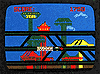
Experience the world of words with the Jetsons in a colorful and action-packed video game. It's easy to improve your spelling, reading and word recognition skills when you're having fun doing it. Especially when your instructors are the Jetsons. The programs progress through grade levels, from preschool on up.
DEVELOPMENT HISTORY
With the introduction of the Entertainment Computer System, a new department was added to Applications Software - Educational Product - to develop educational games for the system. Of the three games they helped design - Jetsons, Number Jumble and Flintstones Keyboard Fun - this is the only one that was released.
 FUN FACT: Parents may have been wary of selecting this game to teach their children. In promising that the game develops vocabulary skills, "develops" is spelled incorrectly on the box as "developes."
 Melody Blaster
ECS MUSIC SYNTHESIZER CARTRIDGE [#4540]
Aka: Astromusic
Design/Program: Rick Sinatra
Music: Hal Cannon
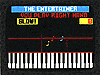 CATALOG DESCRIPTION
The musical version of the popular video game, Astrosmash. And a fun, new way to learn musical notation. As musical notes fall from the sky in the pattern of a popular song, you must play the right keys to shoot them down. The faster you shoot down the notes, the faster you're learning to play your favorite songs!
DEVELOPMENT HISTORY
The VP of Design & Development, Richard Chang, loved music-based games and toys; the ECS had a music synthesizer due to his pushing. This cartridge for the music sythesizer was based on his idea.
FUN FACT: This was the only cartridge released for the ECS Music Sythesizer.
FUN FACT: Marketing kept pushing this as a musical version of Astrosmash, and in early catalogs even called it by the name Astromusic.
ECS MUSIC SYNTHESIZER CARTRIDGE [#4542/UNFINISHED]
 CATALOG DESCRIPTION
Compose your own melodies, right before your eyes. Play on the Synthesizer and watch the notes appear on your TV screen. You can compose all kinds of music, from Bach to rock. And your favorite compositions can be stored on cassette (both the sound and notation) for future playback or editing.
DEVELOPMENT HISTORY
This cartridge was to have been programmed in Design & Development, but the department was closed August 4, 1983, before any substantial work could be done.
 Mind Strike
ECS CARTRIDGE [#4531]
AKA Mindstrike
Design/Program/Music/Sound: David Warhol
Gameboard designs: David Warhol and Mark Buchignani
Graphics: Connie Goldman, Peggi [Decarli] Fiebig, Joe [Ferreira] King
 CATALOG DESCRIPTION
A futuristic, 3-dimensional space version of a chessboard game. Pit your skill against a computer, or another player. Alternate turns with your opponent or move simultaneously for a fast-action game. You can even sit back and watch the computer play itself. Use the keyboard to program the computer opponent to match your skill as you master the game. Select from over 50 challenging game boards.
DEVELOPMENT HISTORY
Mind Strike was an original game that David Warhol had created before coming to Mattel Electronics.
He started work on it as an Intellivision cartridge. Since the Master Component didn't have enough memory for a computer player, he designed it as a two-player game.
When the Entertainment Computer System was introduced with its extra RAM, Dave was asked to change Mind Strike to a one- or two-player ECS cartridge. He proposed making it two-player for Intellivision, one-player for ECS, but Marketing insisted on it being unplayable without the ECS module in order to boost ECS sales.
FUN FACT: David Warhol called the game Mindstrike; he wasn't happy when Marketing changed it to two words.
FUN FACT: All the game boards are symmetrical; they look the same when viewed upside-down. So Dave had the name Mind Strike on the title screen designed so that it, too, reads the same upside-down.
 EASTER EGG: Dave's favorite number is 47 (it's a thing amongst Pomona College alumni), so board 47 reads "DAVE."
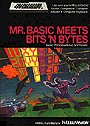 Mr. BASIC Meets Bits 'N Bytes
ECS CARTRIDGE [#4536]
Design: Design & Development Department
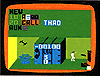 CATALOG DESCRIPTION
An introduction to computers and BASIC programming through the fun of a video game. Control "Mr. BASIC" and capture the "Bits" and "Bytes" in one of three exciting games. Learn to write simple programs on the Computer Keyboard. Or, use the hand controllers just for fun. These programs use our unique color-coded graphics system to make learning programming as easy as a game.
DEVELOPMENT HISTORY
The Entertainment Computer System hardware and internal software was designed and programmed in the Design & Development department headed by Richard Chang. This game was intended to teach users the simplified BASIC language built into the ECS.
FUN FACT: This game has the longest instructions of any Intellivision game, consisting of a 72-page spiral bound instruction book
ECS MUSIC SYNTHESIZER CARTRIDGE [#4545/UNFINISHED]
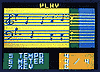 CATALOG DESCRIPTION
Now you have a private music teacher, right in your own living room. Play along with selected songs by following the written music on your TV screen. An arrow guides you on your way, pointing to the notes you should be playing. Or practice drills like pitch guess, interval recognition, phrase recall and fingering exercises. Makes music lessons fun!
DEVELOPMENT HISTORY
This cartridge was to have been programmed in Design & Development, but the department was closed August 4, 1983, before any substantial work could be done.
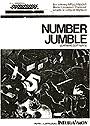 Number Jumble
ECS CARTRIDGE [#4544/UNRELEASED]
AKA Adder Attack, Math Machine
Design/Program: Tom Priestley
Design/Educational content: Mona Theiss, Elaine Xenos-Braswell, Pamela Dong
Graphics: Joe [Ferreira] King
Music/Sound Effects: Joshua Jeffe
PACKAGE DESCRIPTION
Cut across fire in a Time Sailer, cruise under water in a Submarine, fly through thin air in a Zeppelin, or roll across the Earth in a Tank -- but never stop firing at the dreadful creatures that beset you! Shoot them down with the fireballs you control and they'll turn into black numbers. When you shoot enough creatures, you get a chance to solve exciting mathematical equations...and score big points! Hurry, for every second counts! Have fun!
PRODUCTION HISTORY
Early in 1983, Mattel Electronics created an Educational Products department to develop educational game ideas, primarily for the Entertainment Computer System.
Number Jumble was one of the ideas that came out of that department. Others that went into production were Jetsons' Ways With Words and Flintstones Keyboard Fun.
The game was completed late in 1983. Packaging reached the black & white mockup stage, but Mattel Electronics was closed before the game could be released.
Although designed for the Entertainment Computer System, the game was played with the hand controllers. The ECS keyboard was only used if the player needed to do scratchpad calculations before entering answers.
 Scooby Doo's Maze Chase
ECS CARTRIDGE [#4533]
AKA Three Blond Mice, Three Blind Mice
Scooby Doo used under license from Hanna-Barbera Productions, Inc.
Design/Program: Mark Kennedy
Graphics: Monique Lujan-Bakerink, Connie Goldman, Mark Buczek
 CATALOG DESCRIPTION
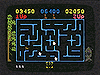
You're Scooby-Doo chasing ghosts through a baffling maze. When suddenly you discover you're the one being chased -- by the evil skull and crossbones. Drop magic obstacles to slow the Jolly Roger's pursuit. Choose from 10 preprogrammed mazes. Or, use the computer keyboard to create your own.
DEVELOPMENT HISTORY
This was an original game called Three Blind Mice designed by Mark Kennedy (actually Mark named it Three Blond Mice, but it wound up on Marketing schedules as Blind). But Marketing was looking for games to drop the expensive cartoon licenses they had obtained into. Thus, Three Blind Mice became Scooby Doo's Maze Chase.
ECS CARTRIDGE [#4537/UNRELEASED]
Trademark used under license from NFL Properties
Design/Program: Mark Buchignani
 CATALOG DESCRIPTION
So realistic you'll be checking for grass stains. This fast-paced game has penalties called and game stats displayed. Includes extra burst of speed for offensive players.
ECS CARTRIDGE [UNRELEASED]
AKA Soccer II, Super NASL Soccer
Produced at Mattel Electronics France
Includes code from the previously released NASL Soccer
 DESCRIPTION
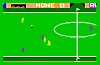
A four-player version of the original NASL Soccer cartridge.
DEVELOPMENT HISTORY
One of the features of the Entertainment Computer System was the ability to add a second pair of hand controllers. Two games went into development to take advantage of this feature: Super NASL Soccer and Doubles Tennis.
The popularity of Soccer in Europe made it a natural to be programmed at Mattel Electronics France.
The nearly-complete cartridge -- without the four-player feature yet -- was shown at the January 1984 Consumer Electronics Show as Super NASL Soccer, but Mattel Electronics closed two weeks later. An agreement with the French office, which stayed together under the name Nice Ideas, gave them the right to complete and sell a version of the game without the Mattel Electronics name.
Nice Ideas turned the game into World Cup Soccer, a one- or two-player, non-ECS cartridge, which was released in Europe by Dextell Ltd. Terry Valeski's INTV Corp. negotiated the rights to distribute the cartridge in the United States, introducing it in Spring 1986.
FUN FACT: Mattel Electronics Marketing tried to interest several companies into advertising in the cartridge. A version was produced with brand names, such as Coca-Cola, appearing on banners around the stadium. No deals were made before Mattel Electronics closed, but a photo of Super NASL Soccer showing the advertising banners was inadvertently used in one of the INTV Corp. catalogs selling World Cup Soccer.
 World Series Major League Baseball
ECS/INTELLIVOICE CARTRIDGE [#4537]
Design/Program: Eddie Dombrower
Voice Implementation: Steve Ettinger
Voice Processing: Mattel Speech Lab
Music/Sound Effects: David Warhol
 CATALOG DESCRIPTION
It's just like playing baseball in front of national TV! The TV cameras catch different angles of the game. Pan across the playing field. Even pick up the baserunners on a split screen. Be the manager by programming in batting and pitching statistics for your team. Program Hall of Famers to play against each other. Imagine Fernando Valenzuela pitching against Babe Ruth! Truly the next generation of video games.
DEVELOPMENT HISTORY
Major League Baseball launched the Intellivision; Marketing hoped a super-Baseball cartridge would do the same for the Entertainment Computer System. This was to be the most complex Intellivision game yet, using both the ECS and Intellivoice.
Programming started as a team effort of Ken Elinger and Eddie Dombrower, but it quickly became a solo effort of Eddie's.
The results were spectacular. Eddie designed the screen views as if the game were being covered by multiple television cameras there were even insert shots appearing in the corners.
And the gameplay, based on real ball player statistics, was beyond any other video game sports cartridge.
Unfortunately, by the time the game was released, Mattel Electronics management had changed and the ECS had dropped to a low marketing priority. The system - and the game - received little support. Few people ever saw the game.
Ten years later, a new generation of "virtual reality" baseball games hit the computer market. Reviewers raved about their multiple-TV-camera viewpoints and statistics-based game play, features World Series Major League Baseball pioneered in 1983.
FUN FACT: Eddie Dombrower used historic and current ballplayers' names and stats to create the players in his game. The original marketing even advertised this, as in the catalog description above. But at the last minute, the legal department told him he couldn't use the real names. So Eddie changed their last names to those of the Mattel Electronics programmers. The first names - nicknames - are inside jokes about the programmers. (He slipped in a few personal references, too, including Paul Jule, his brother's first and middle names, and Joe "Pug" Menosky, his best friend from college.) The stats, though, are still those of the real players. Any true baseball fan can look at the stats and tell who the players are.
FUN FACT: Steve Ettinger continually annoyed Lynn [Lilliedahl] Fordham by calling her "Babe." Finally, one day she turned on him and said, "That's MS. Babe to you." So for the game a player was named Babe Lilliedahl. The legal department, though, made Eddie take it out - they wouldn't allow any of the NICKNAMES to be those of real ballplayers.
 NOT-SO-FUN FACT: This may have been the first integrated video game - Eddie had designed the animated players to be black or white depending on the real players they were based on. When the names were changed to those of the programmers, he left the skin colors as they were. At least one programmer, though, came to Eddie and asked for "his" skin color to be changed, not wanting to be black in the game.
The Gaming Network featured "betting" games, with the word "bet" always in quotes or following the word "simulated" or "make-believe," lest people think Mattel was promoting gambling. In fact, the word "gambling" was forbidden in the packaging, instructions, and catalog descriptions of these games.
Gaming Network cartridges were released in green boxes. Several of these games were also released under the Sears brand name in different packaging.
 Las Vegas Roulette
INTELLIVISION CARTRIDGE [#1118]
Also released by Sears
AKA Roulette
Produced by APh Technology Consultants for Mattel Electronics
Program: John Brooks
 CATALOG DESCRIPTION
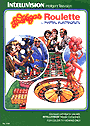
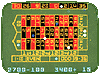
Can you parlay your pile of chips into a fortune? Do you dare risk it all on a single number that you just know is due to come up on the next spin of the wheel? Here's a great party game with all the sound and color of the big casino. Place your "bets"...all "bets" down? Then here goes the big wheel of fortune -- clickety-click-click -- and cross your fingers as the wheel slows and the ball bounces toward your lucky number.
 Horse Racing
INTELLIVISION CARTRIDGE [#1123]
Also released by Sears
Produced by APh Technology Consultants for Mattel Electronics
Program: Chris Hawley
 CATALOG DESCRIPTION
A great game of make-believe for up to 6 players. It's like spending a day at the races. Study the tout sheet. Pick a winner -- or a loser. The odds will change. Go for a long shot or play it safe. They're off and the excitement begins. Cheer your horse on. You could clean up -- on paper. A fun party game.
 Las Vegas Poker & Blackjack
INTELLIVISION CARTRIDGE [#2611]
Also released by Sears
AKA: Poker & Blackjack
Produced by APh Technology Consultants for Mattel Electronics
Program: David Rolfe
 CATALOG DESCRIPTION
From the shuffle of the cards...to the clinking of the coins...to the felt green of the gaming table...to the shifty eyes of the dealer, Intellivision has captured the flavor and the color of casino card games.
Play poker! Five card stud or draw. Seven card stud. This dealer plays tough. He raises, drops, even bluffs. Play carefully because he'd like nothing better than to empty your wallet.
When you've had enough poker, relax with a few hands of blackjack. Play real casino style and double down when you feel hot!
 FUN FACT: Because it came free with the Intellivision Master Component during 1980, 1981 and most of 1982, Las Vegas Poker & Blackjack had the most distribution of any Intellivision cartridge: over 1,900,000 shipped by the end of 1982. When it was eventually replaced by Astrosmash as the free cartridge, distribution fell dramatically; only 2,500 Las Vegas Poker & Blackjack cartridges were shipped in the first six months of 1983.
INTELLIVISION CARTRIDGE [UNRELEASED]
AKA Craps
Produced by APh Technology Consultants for Mattel Electronics
PRODUCTION HISTORY
APh completed (and was paid for) this adaptation of the dice game Craps, but it doesn't appear to have ever been announced or scheduled by Marketing for release.
 Royal Dealer
INTELLIVISION CARTRIDGE [#3758]
Working titles: Cards, Card Fun
Produced by APh Technology Consultants for Mattel Electronics
Program: Rich O'Keefe
 CATALOG DESCRIPTION
If you don't always have someone to play cards with and you're not challenged enough by Solitaire, this cartridge introduces you to three players and three different card games: Hearts, Rummy and Crazy Eights. Your computer deals the cards and keeps score. You can choose to play against one, two or three players.
PRODUCTION HISTORY
While a fairly minor release (36,000 initial shipment), Royal Dealer had a major effect on the development cycle inside Mattel Electronics. Long overdue from APh, when the game was finished it went straight into production with only brief playtesting by a few other programmers. When it was too late, it was discovered that the cartridge contained a major -- and easy to come across -- bug that crashed the game. Because of the low sales expected, Marketing decided to ship the cartridge anyway with an errata slip, but they were furious. The Quality Assurance department, which had frequently been bypassed on late games such as this one and B-17 Bomber, was immediately given life-or-death authority over all future games: nothing was allowed to be released until the official game testers Traci Roux and Dale Lynn had signed off on it. They were merciless: stomping on a game then gleefully showing the videotaped results to the programmer when they found a bug. But it paid off; to this day, we haven't seen any reports of bugs in games they approved.
 BUG: Recreating the bug discussed above was outlined in a September 30, 1982 memo from game tester Traci Roux to Joel Crain, head of Quality Assurance:
The following steps lead to the problems with Royal Dealer. They occur in all four games.
Because of this bug, the following errata slip was added to the packaging: "Please correct your instruction booklet on Page 2 to read: You can only rearrange your cards each time it is your turn before playing or discarding a card from your hand. Once you have played or discarded, you must wait until your next turn before rearranging your cards."
Intellivision was promised as an educational as well as an entertainment product, and one of the first four titles released, The Electric Company Math Fun reflected this. However, Mattel quickly saw where the money was -- sports and arcade titles -- and educational games were put on the back burner.
Only two titles came out as part of the orange-boxed Children's Learning Network. No others were even in development. (Partly this was due to the belief that the Intellivision Keyboard Component was better suited to educational games.) Each of these games ultimately sold just under 150,000 copies -- low by Intellivision standards.
 The Electric Company Word Fun
INTELLIVISION CARTRIDGE [#1122]
Trademark used under license from Children's Television Workshop, Inc.
AKA Word Fun
Produced by APh Technology Consultants for Mattel Electronics
Program: Kevin Miller
 CATALOG DESCRIPTION
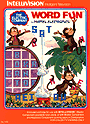
How those little monkeys love to learn! Watch them swing through the jungle, capturing letters with their tails and making words.
Three great learning games. Find A Word has little learners weaving words in and out of each other. Word Hunt sends them into the jungle looking for missing letters.
And Word Rocket has them blasting vowels into the sky to make words out of clouds of consonants. It's the fun and easy way to improve vocabulary skills.
PRODUCTION NOTES
Find A Word was renamed Crosswords between the printing of the catalogs and the release of the cartridge.
The three games in the Word Fun cartridge were recycled in the Learning Fun II cartridge from INTV Corporation.
 BUG: The game won't work when plugged into an Intellivision II. A feature to keep early Coleco-produced Intellivision cartridges from working in the Intellivision II inadvertently keeps Word Fun from working also. Marketing didn't feel Word Fun was important enough to hold up release of Intellivision II to fix the problem.
 FUN FACT: The fact that Word Fun didn't work with Intellivision II allowed one group of kids to get copies of every Intellivision game for $1.95 each. Ringleader Mark Thompson wrote to explain the scam:
"When the Intellivision II came out, we found out that Word Fun didn't work on the new version and so we called Mattel to see what was going on. When we found out that Mattel was offering to replace the Word Fun cartridges with any other game we wanted, we went down to their place in Hawthorne.
"One day I went to Kay-Bee Toys for new games and saw that Word Fun was only $1.95. To make a long story short, every Kay-Bee store in the LA area was able to sell completely out of Word Fun! We would get a carload of our friends (I was 14 at the time) and make a field trip of going down to turn in our Word Fun cartridges for new games. We'd have about 6 people in the car and each of us would turn in two Word Fun games at a time about once a week (a self-imposed limit because I didn't want to ruin this). The fact that we were able to do this for about six months surprised me. Plus I made a lot of money selling the newest cartridges for about $25 apiece."
 The Electric Company Math Fun
INTELLIVISION CARTRIDGE [#2613]
Trademark used under license from Children's Television Workshop, Inc.
AKA Math Fun
Produced by APh Technology Consultants for Mattel Electronics
Program: Kimo Yap
 CATALOG DESCRIPTION
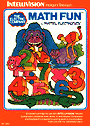
Who would guess that learning basic arithmetic skills could be this much fun!
To solve the math problems, two players race their clever gorillas along the river bank, ducking past obstructing animals.
The math gets more challenging when the players are ready for it. Addition, subtraction, multiplication and division -- all are more fun with Math Fun.
PRODUCTION HISTORY
Although it has a higher production number than Word Fun, Math Fun was released first -- it was one of the original four cartridges test marketed in 1979.
Initially, the solutions for math problems had to be entered ones column first. For example, when subtracting 5 from 24, the solution, 19, would have to be entered as 9, then 1. While this was designed to duplicate how people solve problems with pencil and paper, many customers complained; intuitively, they wanted to simply press in 1 then 9. A running change was ordered so that later copies of the cartridge use this intuitive method of entry, instead.
The Electric Company Math Fun was recycled as the game Math Master on the Learning Fun I cartridge from INTV Corporation.
By the end of 1981, Intellivision had the reputation for the best sports titles and Atari had the reputation for the best arcade games. In 1982 the battle was over who had the best space cartridges. The movie Star Wars in 1977 had sparked a science fiction resurgence, which hit a peak in 1982 with the release of E.T.: The Extra-Terrestrial. Mattel Electronics turned to the same TV-commercial strategy they used to establish their sports titles: a side-by-side comparison of an Atari game with an Intellivision game, in this case Asteroids versus Star Strike. The strategy paid off; four of the five released Space Action Network games approached the 1,000,000 mark in sales, with the fifth, Space Hawk, reaching 500,000.
Atari fought back with its highly publicized multi-million dollar purchase of the videogame rights to E.T. Atari used the anticipation for this cartridge to sell their 2600 console. Cleverly, Mattel countered by hiring E.T. star Henry Thomas to join spokesperson George Plimpton in Intellivision commercials. Mattel's lawyers, however, to avoid a lawsuit, didn't allow Thomas's connection to the movie, or to science fiction, or even his name to be mentioned in the commercials. (While the anticipation of the E.T. cartridge may have succeeded in selling Atari consoles, its actual release was the greatest flop in the videogame industry.)
Surprisingly, given the success of the Space Action Network, Mattel put no space titles into production for the Intellivision during 1982 or 1983 with the exception of the never-finished Target: Andromeda.
All of the games on this page were released in Space Action Network dark blue boxes. A couple of these games were also released under the Sears brand name in different packaging.
 Space Battle
INTELLIVISION CARTRIDGE [#2612]
Also released by Sears [#4975212]
Produced by APh Technological Consulting for Mattel Electronics
Program: Hal Finney
 CATALOG DESCRIPTION
The alien squadron is closing in on your Mother Ship. You're awesomely outnumbered, and they attack and attack...
Flick on the situation map and analyze your position. Dispatch a fighter squadron toward the closest alien cluster.
You're smarter, a little faster, and you're going to let these aliens know they've got a fight on their hands.
Flick back to a cockpit close-up view. Here they come! Aim lasers...fire!
PRODUCTION NOTE
An M Network version of the game, called
Space Attack, was released for the Atari 2600.
 PLAYING TIPS: From Intellivision Game Club News, Issue 2, Winter 1982 (credited to "Hal, one of our creative programmers"):
Strategy Mode (radar screen)
Battle Mode
INTELLIVISION CARTRIDGE [UNFINISHED #3605]
Produced by APh Technological Consulting for Mattel Electronics
CATALOG DESCRIPTION
Galaxian strategy! Hordes of oncoming aliens swoop down on your star-ship! You defend your position -- parrying, blasting, avoiding the torpedoes! Wave after wave of them march down upon you...will you save the star-base? Only your command of strategy can help you!
PRODUCTION HISTORY
Although included in early Intellivision catalogs, a prototype of this game was never demonstrated; it's not clear how much work was actually ever done on it. Designed to be a Galaxian clone, it was probably abandoned for fear of a lawsuit. (Possibly it was in development with the hope of obtaining the license, and abandoned when Mattel failed to get it.) While called Arcade in the catalogs, this was most likely a working title. (Triple Action was developed under the working titles 5-in-1 Arcade and 3-in-1 Arcade.)
 Space Armada
INTELLIVISION CARTRIDGE [#3759]
Produced by APh Technological Consulting for Mattel Electronics
Program: John Brooks &Chris Hawley
 CATALOG DESCRIPTION
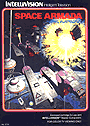
You're defending Planet Earth against the unrelenting attack of alien warlords.
At first they throw their light brigades at you. If you're quick and careful, you should be able to elude their bombs, moving out of the way or taking refuge behind a bunker.
But when you wipe out the first couple of brigades, they'll launch a more deadly attack, dropping faster, more lethal bombs. Clear the battlefield once more, and they'll resort to guided missiles and even more fiendish devices.
You've got your hands full -- of excitement and aliens!
PRODUCTION HISTORY
Space Armada is a clone of the arcade game Space Invaders. According to Mattel lawyers, the copyright of the original game hadn't been properly protected. Any other company could make their own version as long as they changed the name ("Space Invaders" is a trademark).
Space Armada was the first Intellivision game to take advantage of sequencing GRAM to create the illusion of more than eight moving objects (sprites) on-screen at one time.
PLAYING TIPS: From Intellivision Game Club News, Issue 3, Summer 1982:
 Astrosmash
INTELLIVISION CARTRIDGE [#3605]
Working titles: Rocks, Meteor! + Avalanche
Design & Program: John Sohl
 CATALOG DESCRIPTION
Spin. Blast. And drop into hyperspace to avoid a killer asteroid shower. Power on. Attack computer engaged. Fire a quick burst at the alien antagonists. Got 'em!
Now take a deep breath and relax. But only for a fraction of a second, because more trouble is on the way.
You're all alone in a hostile universe of tumbling asteroids and homicidal aliens. You've got the wits and the speed, but you're awesomely outnumbered.
With a little practice, you may survive...
PRODUCTION HISTORY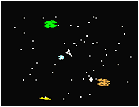 Astrosmash started out as a clone of the arcade game Asteroids, called Meteor!. The game wasn't very big, so John Sohl used the extra room in the cartridge to come up with a variation called Avalanche using the same graphics and sound effects. At the last minute, afraid of a lawsuit from Atari, the Mattel lawyers killed the Asteroids-like Meteor!. Rather than risk introducing bugs by deleting code, John simply put a branch around the opening-screen menu straight into the Avalanche! variation, which was released under the name Astrosmash.
John admits he wasn't sorry to see Meteor! go -- he hadn't been happy with the game, much preferring the Avalanche! version.
Astrosmash quickly became one of the most popular Intellivision games thanks in large part to a very simple technique John programmed in: like most arcade-style games, Astrosmash gets faster and harder at higher levels, but unlike most arcade-style games, as you start to lose lives, the game gets easier again. The game then is never too easy or too hard, making it extremely addictive and making it possible for even a beginner to play a single game for over an hour.
The popularity of Astrosmash was such that late in 1982 it replaced Las Vegas Poker & Blackjack as the cartridge shipped with the Intellivision Master Component. By June 1983, the last date for which figures are available, 984,900 copies of Astrosmash had been shipped, making it the most widely distributed cartridge by any of the Blue Sky Rangers (trailing only the APh produced Las Vegas Poker & Blackjack and Major League Baseball cartridges). John Sohl was rewarded with a plaque from Mattel and a better offer from Activision, which he took (after finishing B-17 Bomber).
An Aquarius version was also released, as was an M Network version called Astroblast for the Atari 2600. A musical adaptation, Melody Blaster, was released for the ECS Music Synthesizer. An obscene version, called...well, we can't tell you what it was called, was developed for in-house use only. The story of this version can be found in a TRON Solar Sailer FUN FACT.
 BUG: There's no check for the score overflowing -- beyond 9,999,999 points, the scoring routine starts displaying negative numbers, letters, and other ASCII characters. (Ironically, the catalog description promises "Unlimited scoring potential.")
BUG: John simply branched around the code for the Asteroids version of the game; the code is still in the cartridge. Verrrry rarely, when there's a glitch hitting RESET, the Asteroids version will show up on screen. (This would be a dandy Easter egg if it were intentional or reliably repeatable, but it's neither.)
PLAYING TIPS: From Intellivision Game Club News, Issue 1, Fall 1981:
Here is some extra ammunition from John P. Sohl, creator of Astrosmash. [Note: this issue was the only time that Intellivision programmers were publicly referred to by name until the inclusion of credits on cartridges late in 1983. The same issue mentions Mike Minkoff as the creator of Bowling.] Sohl says you'll be unbeatable if you follow three basic rules: don't get hit, shoot anything that moves and never take risks unless you have to.
Sound easy? It is if you practice Sohl's special techniques for hitting your targets.
Precision aiming is important. To get the highest scores, Sohl says to leave the anti-fire on and steer with the directional wheel using the firing button to get off extra shots as you need them. Keep on shooting!
 FUN FACT: The unused Asteroids-version code was recycled in the game Space Hawk.
FUN FACT: Late in 1981, Mattel held a series of local "Intellivision VideoChallenge Tournaments" in Washington DC, Baltimore, New York, Philadelphia, Chicago and Los Angeles benefiting Variety Clubs International. Contestants competed for prizes (Grand Prize: an RCA projection TV) playing Major League Baseball, Auto Racing, and U.S. Ski Team Skiing. The publicity was so good, that Marketing took the idea national in 1982 with the "$100,000 Astrosmash Shootoff."
 From March until August 11, Intellivision owners were invited to send photographs of their TV screens showing their high score in Astrosmash. Just for entering, they would receive an Astrosmash Shootoff patch, and it was announced that 16 regional high-scorers would be flown to Houston to compete for eight cash prizes.
Over 13,000 people entered, and quickly it became obvious there was a problem. First, because of the scoring bug, many of the pictures showed scores made up of seemingly random ASCII characters. John Sohl had to review the photos and, with an ASCII table, decipher the actual scores. Second, it turned out that no one in Marketing realized that Astrosmash, like many Intellivision games, can be played at slower speeds simply by starting the game by pressing 1, 2, or 3 instead of the disc. (This is a feature programmed into the EXEC.) There was no way of telling who had legitimately obtained a high score and who had played at the easiest speed. There were reports of competitors who literally played for days at the slowest speed, pausing the game (pressing 1 and 9 simultaneously, also programmed into the EXEC) to sleep or go to school.
Unable to decide who was legit and who wasn't, instead of the announced 16, Mattel Electronics wound up flying 73 entrants to Houston for an all-expense paid weekend, September 11 & 12, 1982. There, the entrants competed in 1 hour of timed play. 18-year-old Manuel Rodriguez of Stockton, California won the $25,000 top prize with a score of 835,180.
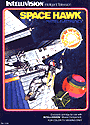 Space Hawk
INTELLIVISION CARTRIDGE [#5161]
Also released by Sears
Design & Program: Bill Fisher, John Sohl
Graphics & Sound: Bill Fisher
 CATALOG DESCRIPTION
You're equipped with a jetpack for directional avoidance control, a blaster for protection and 5 force shields. If you get hit, you lose a shield. Not only that, you're sent into a space spin that could be disastrous. While you're regaining control, UFOs and comets scream past you. Of course, you can use hyperspace to get out of a super-tight spot. That'll put a few million light years between you and danger. But, watch out. You could wind up in an even hotter spot. If you want to find out how good you are, invite a friend over, compare scores.
PRODUCTION HISTORY
Most new programmers started their first day with a copy of a simple training game called Killer Tomatoes. They were expected to spend a few weeks playing with it and modifying it to get a feel for how the Intellivision system worked before being assigned to a real game.
Bill Fisher, however, had a different training game. On his first day in June 1981 he was given John Sohl's original Asteroids version of Astrosmash. He was told to modify it into a game that would still be like Asteroids, but different enough that the Mattel lawyers would allow it to be released. Space Hawk was the result. (And while he was at it, he fixed the bug in displaying the score.)
FUN FACT: While testing the game, Bill came across a bug: every now and then, the game would, seemingly at random, hyperspace you. He and his boss, Mike Minkoff, went over the code with a fine-tooth comb before realizing what the problem was: the Intellivision hand controllers encode button presses in such a way that an action (side) key pressed at the same time as particular directions on the disc will be interpreted instead as a numeric key being pressed. There was no software way around this; shooting while moving would occasionally be interpreted as pressing 9 -- the hyperspace button.
After several days of puzzling over a solution, the bug was ultimately "fixed" by including the following note in the instruction manual:
"Every once in a while, your space hunter will move near a 'black hole,' and the computer will automatically put him into HYPERSPACE. This will cost you the same number of points as if you had pressed the HYPERSPACE key yourself. On the other hand, it will save your hunter."
This led to an axiom frequently heard around Mattel: If you document it, it's not a bug -- it's a feature. Anytime a game in development crashed -- no matter how badly or bizarrely -- witnesses would invariably turn to the frustrated programmer, shrug, and calmly say "document it."
 Star Strike
INTELLIVISION CARTRIDGE [#5136]
Produced by APh Technological Consulting for Mattel Electronics
Program: Hal Finney & Brett Stutz
 CATALOG DESCRIPTION
For action fast and furious, take command of a rocket-powered fighter-interceptor flying a few hundred feet off the deck. Your mission: attack and destroy alien silos defended by several squadrons of alien rocket-craft. You must react instantaneously. You are a few hundred feet above the terrain in a narrow canyon. That's where the aliens have dug in. Maneuvering room is severely limited. Meanwhile, earth is slowly coming into target position for the silos. Remember, you alone can save earth. Don't miss.
PRODUCTION HISTORY
Inspired by the Death Star trench sequence from the movie Star Wars, Star Strike is actually a very simple game; most players quickly learn the timing of it to consistently win. But visually it was stunning, with a 3-D effect (accomplished by sequencing GRAM) not seen before in a home videogame. Heavily promoted, it was the top-selling Intellivision game of 1982, with nearly 800,000 units shipped that year.
An M Network Atari 2600 Star Strike was also released.
BUG: Hold down the left controller disk in a single position while simultaneously pressing one of the top action keys. The fighter will soon remain in a fixed position on the screen. Release the disk to unfreeze the fighter.
PLAYING TIPS: From Intellivision Game Club News, Issue 3, Summer 1982:
FUN FACT: The Star Strike TV commercial became probably the most notorious of all videogame commercials of its era, with Mattel Electronics spokesperson George Plimpton bragging about "our most amazing visual effect ever: the total destruction of a planet!" while the earth is seen being blasted to pieces. Comedians, cartoonists and politicians all jumped on this as an example of the glorification of violence in videogames.
No doubt about it, these are the games that first sold the Intellivision. An early TV and print ad showing a side-by-side comparison of baseball played on an Atari 2600 and on an Intellivision made the Atari version look laughable. The Intellivision was established as the serious sports-game machine, and Major League Baseball went on to become the best-selling Intellivision cartridge.
Mostly programmed for Mattel Electronics by APh Technological Consulting in 1979 and 1980, the games are impressive, especially when keeping in mind that all of them (except for Motocross) are only 4K in size. Also, most of these games require more than seven players and a ball to appear on screen at the same time -- difficult since the Intellivision can only draw eight moving objects on screen. Tricky swapping of players from static background drawings to moving objects and back achieves the illusion of more than eight moving at once.
The main drawback to these games is that most require two players. By 1981, work was starting on second-generation sports games that featured computer opponents; several of these were eventually released by INTV Corporation.
The Sports Network games released by Mattel were in royal blue boxes (with the exception of Motocross, which was released after the themed "network" concept had been dropped). Several of these games were also released under the Sears brand name in different packaging. All of these games first appeared in 1980 except Bowling and Boxing, which came out in 1981, and Motocross , which was finally shipped in 1983.
 Auto Racing
INTELLIVISION CARTRIDGE [#1113]
Also released by Sears
Produced by APh Technological Consulting for Mattel Electronics
Program: Larry Zwick
 CATALOG DESCRIPTION
Snap on your crash helmet, fire up your Formula I, and slam it into first. Power through the first turn and you're off on a Grand Prix class racing circuit.
The faster you push your race car the more alert you have to be. You may slide off the track and into a maze of grass and trees. You may find yourself skidding into a pond. Or you may find yourself halfway through a hairpin turn before you know it.
Whether you race against an opponent or against the clock, there are thrills enough for anybody
DEVELOPMENT HISTORY: There were two versions of Auto Racing released due to a running change made during manufacturing. In the original version, steering is realistic -- it is oriented to the car. For example, if your car is moving downward on-screen and you want to turn right (that is, toward the left of the screen), you press right on the hand controller disc. Mattel received complaints about how difficult this was (even the instruction book warns that it takes some getting used to), so a running change was ordered to make steering intuitive -- to orient it to the screen. In the above example, to turn toward the left of the screen, you press left on the hand controller disc, even though the car is actually making a right.
Both versions had their advocates -- intuitive steering being easier to play; realistic steering being a better simulation of driving. One programmer likened it to the difference between driving an automatic and driving a stick. Unfortunately, there's no way to tell which version is which from the package; you either have to check the instruction book, or just plug in the cartridge and play.
 FUN FACT: The five courses are mapped on a globe; you can drive off one, through the trees, and onto another, or onto the hidden drag strip. Drive off at the right place and the trees are spaced so that, without touching the hand controller, your car will circle the globe forever (well, until the screen-saver times out).
 NHL Hockey
INTELLIVISION CARTRIDGE [#1114]
Trademark used under license from NHL Services, Inc.
Also released by Sears as Hockey
Produced by APh Technological Consulting for Mattel Electronics
Program: Ken Smith
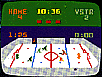 CATALOG DESCRIPTION
Your opponent has a man in the penalty box, so it's time to push hard on offense. There's the whistle! Time to move down the ice. Your team mows toward the opposing goal in perfect formation, nudging the puck back and forth as defenders move in.
You're across the blue line. You send a pass across the front of the goal, then...wham! a screaming slap shot whips past the goalie and in for the score.
The crowd roars its approval. And the buzzer announces the end of the game. You won! A little practice and you'll be ready for the big time.
PRODUCTION NOTE
NHL Hockey was one of the games to be included on the Go For the Gold album cartridge.
 Tennis
INTELLIVISION CARTRIDGE [#1814]
Also released by Sears
Produced by APh Technological Consulting for Mattel Electronics
Program: Gavin Claypool
 CATALOG DESCRIPTION
Thunk! You send a screaming serve across the net. Your opponent races to intercept it and returns a lofty lob into your deep backcourt. You get to it in time to send a smashing ground shot just out of reach of your opponent's outstretched racquet.
Play an entire three set match, and each game will be different and exciting. You control ball placement, velocity and strategy. And it's a game of wits as well as of dexterity. Even the crowd gets in the act by turning their heads to follow the ball -- and cheering at just the right time.
 NASL Soccer
INTELLIVISION CARTRIDGE [#1683]
Trademark used under license from NASL Marketing, Inc.
Also released by Sears as Soccer
Produced by APh Technological Consulting for Mattel Electronics
Program: Kevin Miller
 CATALOG DESCRIPTION
A well executed drive down the soccer field is a thing of beauty. The man with the ball jukes, whirls, passes to his teammate. The teammate dribbles toward the goal until he attracts a crowd of opponents. Then he passes to a third man who sets up the score.
The game action is as realistic as the excitement of Pro Soccer -- minus the black 'n blue shins.
PRODUCTION NOTE
An M Network Atari 2600 version, called International Soccer, was released.
 PGA Golf
INTELLIVISION CARTRIDGE [#1816]
Trademark used under license from the Professional Golfers' Association of America
Also released by Sears as Golf
Produced by APh Technological Consulting for Mattel Electronics
Program: Scott Bishop
 CATALOG DESCRIPTION
Stand steady at the tee...head down...slow backswing. Now, drive your tee shot 220 yards down the fairway, splitting a pair of sandtraps. Loft a five iron onto the green. And sink a twenty foot putt for a birdie!
You control the swing and aim throughout 9 championship quality holes. The fairways and greens are beautifully manicured, but the sand traps are deep...and the rough is...rough!
 U.S. Ski Team Skiing
INTELLIVISION CARTRIDGE [#1817]
Trademark used under license of the United States Ski Team, Inc.
Also released by Sears as Skiing [#4975219]
Re-released by INTV Corp. as Alpine Skiing [INTV #1817]
Produced by APh Technological Consulting for Mattel Electronics
Program: Scott Reynolds
 CATALOG DESCRIPTION
Take a deep breath, dig your poles hard into the snow, push off...and you're speeding down a world class skiing course.
Stay low and glide gracefully through the turns because you're in a race against the clock. But don't cut the comers too sharply or you'll go tumbling! All the excitement of the Winter Olympics on a beautiful video snowscape.
PRODUCTION NOTE
U.S. Ski Team Skiing was one of the games to be included on the Go For the Gold album cartridge.
FUN FACT: A couple years after the game was finished, a Mattel programmer needed to take a look at the original APh source code. He was startled to find that all variables and subroutines were named with the vilest (and most creative) obscenities.
 Boxing
INTELLIVISION CARTRIDGE [#1819]
Also released by Sears
Produced by APh Technological Consulting for Mattel Electronics
Program: Tom Loughry
 CATALOG DESCRIPTION
Slip into the powerfully muscled body of the fighter of your choice. Maybe you'll go for a power slugger. Or an agile defender. Or a completely unpredictable fighter.
There's the bell! You're playing at championship speed, so the action is lightning fast. Feint, duck, block, then move in for a quick combination.
Remember that your fighter is using up precious energy. And each punch he takes has its toll. So use your brains as well as your brawn -- and keep your warrior in shape to go 15 rounds.
PRODUCTION NOTE
Boxing was one of the games to be included on the Go For the Gold album cartridge.
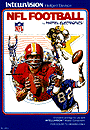 NFL Football
INTELLIVISION CARTRIDGE [#2610]
Trademark used under license of National Football League Properties, Inc.
Also released by Sears as Football
Produced by APh Technological Consulting for Mattel Electronics
Program: Ken Smith, Glyn Anderson (instant replay feature)
 CATALOG DESCRIPTION
The whistle blows! The crowd roars! The two teams sprint onto the field and line up for the opening kickoff.
Your ball, first and ten on the twenty yard line. Will you grind out the yardage on the ground...or risk a long bomb for a quick score? You and your opponent can choose from over 180 offensive and defensive plays -- so it's as much a game of strategy as execution.
Two full halves of fun. With all the refinements of passing, punting, end runs and razzle-dazzles. The computer keeps track of time and score, and the crowd lets you know what it thinks of your performance.
PRODUCTION NOTE
An M Network Atari 2600 version, called Super Challenge Football, was released.
 Major League Baseball
INTELLIVISION CARTRIDGE [#2614]
Trademark used under license of Major League Baseball Promotion Corp.
Also released by Sears as Baseball
Re-released by INTV Corp. as Big League Baseball [INTV #2614]
Produced by APh Technological Consulting for Mattel Electronics
Program: David Rolfe
 CATALOG DESCRIPTION
The crowd roars as the nine man home team sprints out onto the field. Then you and your opponent use all the tricks in the book to score the winning run.
You control all the action -- balls and strikes, hit and run, double plays and stolen bases. And it's not over until the last out of the ninth inning!
DEVELOPMENT HISTORY
Developed at APh during 1979, Major League Baseball came out in 1980 and went on to become the best selling Intellivision cartridge, with 1,085,700 shipped as of June 4, 1983 (the last date for which figures are available). After Mattel Electronics went out of business, INTV Corp. changed the name of the cartridge to Big League Baseball rather than pay to renew the Major League Baseball trademark license.
An M Network Atari 2600 version, called Super Challenge Baseball, was released.
FUN FACT: Major League Baseball is the only cartridge to use the Intellivision sound chip for speech synthesis (the umpire crying "Yer out!"). Marketing put a stop to any further such use, fearing it would hurt sales of the Intellivoice module.
 NBA Basketball
INTELLIVISION CARTRIDGE [#2615]
Trademark used under license of NBA Properties, Inc. and the National Basketball Association
Also released by Sears as Basketball [#4975203]
Produced by APh Technological Consulting for Mattel Electronics
Program: Ken Smith
 CATALOG DESCRIPTION
Two teams square off at mid-court. Up they go for the jump ball. It's tipped to your team. You fake, drive, and move in for a slam dunk!
Each three man team of remarkably realistic athletes can dribble. Pass in any direction, jump, block, steal...even take a casual set shot when they've caught the other guys napping.
Four action-packed quarters -- plus overtime when needed!
PRODUCTION NOTE
NBA Basketball was one of the games to be included on the Go For the Gold album cartridge.
 PBA Bowling
INTELLIVISION CARTRIDGE [#3333]
Trademark used under license of Professional Bowlers' Association
Also released by Sears as Bowling [#4975223]
Program, graphics: Rick Levine, Mike Minkoff
Sound: John Sohl
 CATALOG DESCRIPTION
Warm up by picking up some tricky spares. Now you're ready for ten frames of championship bowling. Select the bail weight you prefer. Decide how "slick" you want the alley. Take a few deep breaths and...you're up!
Aim carefully allowing for loft and curve. Release nice and smooth, and watch the ball plunge into the sweet part of the pocket. Strike! Keep it up, score 200, and you'll get a rousing fanfare.
DEVELOPMENT HISTORY
PBA Bowling was the first Intellivision game actually programmed by Mattel employees: Mike Minkoff and Rick Levine from the handheld-games department. Since Mattel didn't have development equipment yet (1980), Mike and Rick commuted from Mattel in Hawthorne to APh in Pasadena three days a week. Mike gives Rick, an avid bowler, credit for the many realistic details in the game.
 Motocross
INTELLIVISION CARTRIDGE [#3411]
AKA MX
Design: Rick Koenig, Rick Levine
Program: Rick Koenig
Graphics: Rick Levine, Joe Ferreira
Sound: Mark Urbaniec
PACKAGE DESCRIPTION
Speeding up the long straights, blasting through tight S turns, or hurling across wild jumps, you're meant to eat dirt and claim victory! What a racing bike you've got! The competition is fierce, the terrain is rough. Challenge your toughest adversary, then leave him behind, as you cross the finish line!
DEVELOPMENT HISTORY
Started by Rick Levine in 1981 as his follow-up project to PBA Bowling, Motocross was put on hold when Rick left Mattel. (Tired of commuting from Irvine to Hawthorne, Rick took a non-gaming job. Later, he went to work for Imagic, where he programmed the Intellivision games Microsurgeon and Truckin'.) Months later, biker Rick Koenig took a stab at completing the game. After several weeks, he got permission to scrap the existing code and begin from scratch. Only Rick Levine's basic concept and graphics were kept, with new animations by Joe Ferreira.
Rick Koenig approached the game scientifically, writing routines to simulate all the movements of the cycles according to the laws of physics. The result is motorcycles that accelerate, skid and jump realistically.
Although announced in Mattel catalogs in 1981 and 1982 as part of the Intellivision Sports Network, by the time the game was released in 1983 the themed "networks" had been dropped. The Sports Network isn't mentioned on Motocross's final packaging.
FUN FACT: Gravity is a factor in the motion routines. During testing, Rick made gravity adjustable to determine the best looking arc when jumping. Several unsuspecting programmers were invited to test the game, not knowing gravity had been set to zero. The first time their cycles hit a ramp, the cycles would sail up-up-and-away off the screen, while the programmers frantically tapped the controller discs, trying to make them come back down.
FUN FACT: Rick was able to reuse his basic algorithms from Motocross several times: in Racing Destruction Set, a Commodore 64 game for Electronic Arts (produced by his old Mattel boss, Don Daglow), in Stadium Mud Buggies, an Intellivision game for INTV Corp., and in Monster Truck Rally, an NES game also for INTV.
The Strategy Network cartridges were based on classic board games, with the exception of the original title Utopia. Each of these games could be played against a computer player; Marketing liked to hold up these games as proof of the "Intelligent" in "Intellivision."
Strategy Network cartridges were released in purple boxes. Backgammon and Checkers were also released under the Sears brand name in different packaging. Checkers was released with different packaging in Great Britain under the English name Draughts.
 ABPA Backgammon
INTELLIVISION CARTRIDGE [#1119]
Trademark used under license from American Backgammon Players Association
Also released by Sears as Backgammon
Produced by APh Technological Consulting for Mattel Electronics
Program: Kevin Miller
 CATALOG DESCRIPTION
Beating Intellivision at backgammon is a lot of fun. But it's definitely not child's play.
The computer knows all the tricks -- and it calculates all the odds before it moves.
Can you find a flaw in its strategy? Can you give it pieces to gobble up freely, then trap it in the back game? Or will you just cross your fingers, press the button and roll the dice?
Perfect your own backgammon skills with this modem version of one of the world's oldest games.
PRODUCTION NOTES
ABPA Backgammon was one of the original four games introduced with Intellivision when it was test marketed in 1979.
The program code was recycled in the Triple Challenge cartridge released by INTV Corporation.
 Checkers
INTELLIVISION CARTRIDGE [#1120]
Also released by Sears
Released by Mattel in Great Britain as Draughts [#1120]
Produced by APh Technological Consulting for Mattel Electronics
Program: David Rolfe
 CATALOG DESCRIPTION
Pit your skill and imagination against an opponent who can assess the board opposition in a few seconds and think several moves ahead.
The computer won't make a foolish mistake, but you can still beat it...if you concoct a strategy it can't handle.
PRODUCTION NOTES
The game Checkers is known as Draughts in Great Britain, necessitating a packaging change for the English market.
The program code was recycled in the Triple Challenge cartridge released by INTV Corporation.
INTELLIVISION CARTRIDGE [UNRELEASED]
AKA Empire
Produced by APh Technological Consulting for Mattel Electronics
Program: Jeff Ronnie
PRODUCTION HISTORY
Essentially an Intellivision version of the war/strategy board game Risk, Takeover was well-liked among the programmers. Unfortunately, the game used the same colored-squares graphics mode used by Snafu, limiting the screen graphics to colored blocks, plus the eight moving objects. Marketing felt that while the game was good, it looked too boring to be a successful seller. The game was never released.
 USCF Chess
INTELLIVISION CARTRIDGE [#2611]
Trademark used under license from U.S. Chess Federation
AKA: Chess
Heuristics programming: Teletape, Inc.
User interface programming: Russ Ludwick
Graphics: Dave James, Peggi Decarli
 CATALOG DESCRIPTION
A great new way to play the ultimate game of strategy, whether you're a novice, intermediate or expert. Pit your skill against the computer or an opponent. Select from eight degrees of difficulty and a time limit on moves. Move up in skill as you improve.
PRODUCTION HISTORY
A good Chess program was beyond the capabilities of the both the Intellivision hardware and the Intellivision programmers, but Marketing felt that it was a must-have title to establish the Intellivision as more than a toy.
Money was authorized to produce the Chess cartridges with 2K of RAM on board to bolster the insufficient 147 available bytes in the Master Component. No other Mattel Intellivision cartridge was released with onboard RAM.
The gameplay programming was farmed out to Teletape, Inc., a company with experience in Artificial Intelligence. In-house, Russ Ludwick programmed the on-screen display and user interface.
Although on the schedule from early on, the technical difficulties (including a record 19 weeks of testing and debugging) held up release of the cartridge until 1983. When finally released, it did receive the good reviews Marketing was looking for.
The program code was recycled in the Triple Challenge cartridge released by INTV Corporation.
 FUN FACT: Russ tested the program by playing countless games against the cartridge at all levels. He found that when playing at the highest levels, the cartridge was good, but slow. He got in the habit of making a move, then going home and letting the Intellivision think about a response overnight. Because of this, three features were added: (1) the normal Intellivision time-out feature was disabled, (2) a feature letting you switch to an easier level in the middle of a move was added, and (3) a warning that moves at higher levels could take hours -- or days --was put into the instruction book.
 Utopia
INTELLIVISION CARTRIDGE [#5149]
Working title: Island
Design, program: Don Daglow
Graphics: Kai Tran, Don Daglow
Sound: Russ Lieblich
 CATALOG DESCRIPTION
You and your opponent each have an island to rule. Points are accumulated based on the welfare of your island people. You can choose to be a benevolent ruler or an aggressive dictator. Your people need food, housing, and industry for clothing and other essentials. What you cannot manage are natural disasters. A single hurricane could wipe out your crops, sink your fishing fleet, destroy all the homes and factories you've built. Rebels may automatically appear should the welfare of the people drop. They could attack. Classic dilemmas in a game that is sure to become an absorbing classic in its own right.
PRODUCTION HISTORY
In college, Don Daglow had been a fan of mainframe computer simulation games, so it was only natural that he would try a simulation game for the Intellivision. His result, Utopia, was hailed by reviewers for its originality: it wasn't another arcade rip-off, and it wasn't just a video version of an existing game or sport. It was even educational without being boring.
Although Marketing didn't put much of a push behind the game (they preferred graphically splashier, no-brainer games like Star Strike), the reviews (Playboy Magazine put it in their "Video Game Hall of Fame") and word of mouth pushed sales to a respectable 250,000.
Today, Utopia is one of the best-remembered Intellivision game, with some people referring to it as Civilization 0.5, a reference to Sid Meier's later breakthrough computer simulation game.
An Aquarius version was also released.
 Reversi
INTELLIVISION CARTRIDGE [#5304]
Working title: Othello
Produced by APh Technological Consulting for Mattel Electronics
Program: Greg Favor
 CATALOG DESCRIPTION
Three levels of difficulty insure you'll be playing Reversi for a long, long time. Your objective is to take control of the board. Your opponent is either another player or the computer. Either way, it's great fun. As the game progresses, the playing pieces switch from black to white or white to black depending on which player takes control. Your score is continuously displayed on the screen.
PRODUCTION HISTORY
Reversi is an old board game that seems to make a reappearance every generation or so. In the late seventies, it had regained popularity from one toy company under the trademark Othello.
Atari licensed the name Othello for a video game version, but the game itself was in public domain, so Mattel also did a version. In trying to come up with a title for it, Mattel discovered that the classic name of the game, Reversi, had never been trademarked. So Reversi (TM Mattel) became the name of the cartridge.
Intellivoice was introduced with great fanfare in 1982, hitting the market with three titles: Space Spartans, Bomb Squad and B-17 Bomber. But while the Intellivoice and the games were well reviewed, they were not big sellers. By June 1983, only 300,000 each of the voice unit and first games had been shipped (compared to over 3 million Intellivisions); most of these were still on store shelves. The fourth game, TRON Solar Sailer, received only 90,000 orders. The release of a planned International Intellivoice module was cancelled.
In August 1983, the plug was pulled on Intellivoice altogether. Work continued on two titles, Space Shuttle and World Series Major League Baseball, where the voice would become an enhancement only; the rest were canceled. Space Shuttle was canceled later, leaving World Series Major League Baseball to become the fifth and final voice game released. The fact that it works with Intellivoice is mentioned only briefly on the back of the box.
For more information on the history of Intellivoice, check out the Intellivoice Hardware Page.
 FUN FACT: The Major League Baseball cartridge uses the Intellivision's sound chip to generate a crude voice saying "Yer out!" Marketing ordered a stop to further use of the sound chip to synthesize voices, fearing it would hurt demand for the Intellivoice.
CREDITS: All Intellivoice games had scripts by the Creative Media Department (Joey Silvian, Brad Geagley, Glenn Stello) to develop distinct personalities for the voices. Voices were recorded at Fred Jones Recording Services in Hollywood, directed by Joey Silvian. International voices were recorded at studios in France and Italy and smuggled back into the U.S. on tapes marked "blank" to avoid paying duty (really). Voice files were digitized, edited and optimized by the Voice Department (Ron Carlson, Patrick Jost, Deidre Cimarusti, Sandy Disner, Lynn [Liliedahl] Fordham, Irene Pfannkuch). All Intellivoice programs included voice routines written by Ron Surratt and Steve Roney.
The following list includes all Intellivoice games on which programming was actually done. Games completed but never released are marked UNRELEASED; games canceled before completion are marked UNFINISHED.
 Space Spartans
INTELLIVOICE CARTRIDGE [#3416]
Design/Program/Graphics: Bill Fisher & Steve Roney, Mike Minkoff, Brian Dougherty
Sound: Bill Fisher, Bill Goodrich
Voice of the Computer: Keri Tombazian
see also Intellivoice credits
 CATALOG DESCRIPTION
You are the commander of a spaceship. Suddenly, your ship's under attack. "Shields destroyed, Battle Computer one-third down," the ship's computer warns. You've got to hold them off until you can hyperdrive to a Starbase for repairs. "Starbase Two under attack!" The aliens have you in their clutches -- "The battle is over." Four different voices, two screens.
DEVELOPMENT HISTORY
Space Spartans, the first Intellivoice game, was begun in mid-1981 by Brian Dougherty, who only worked on it a short time before leaving to join the startup company Imagic. Mike Minkoff took over the project and developed it further. When Mike was promoted to manager, he passed it off to the team of Bill Fisher and Steve Roney, who really defined the game and made it more than just Space Battle with voice.
At the time the game was in development, all Intellivision cartridges were 4K in size. To accommodate the voice data, Space Spartans was the first to be given a seemingly generous 8K. This turned out to be woefully inadequate; dialogue had to be cut to a minimum, and the sampling rate was dropped to the point where it's difficult to distinguish the male voices from each other. Luckily, dropping these to a very mechanical sound added to the sci-fi feel of the game. Only the female computer voice was kept at a higher rate, since it adds a strong note of personality. (Check out a sample of her voice below.) All the voice games that followed were allocated 12 or 16K; even the foreign versions of Space Spartans (Gli Spartani Dello Spazio, Les Spartiates De L'Espace and Spartaner Aus Dem All) were given 12K each.
Most of the sound effects were written by Bill Fisher, but Bill Goodrich contributed the explosions; this was fortunate, since it helped find a bug in Intellivision II. While playing Space Spartans on an Intellivision II, Bill Goodrich was distressed to discover his explosions sounded "thin." Comparing other released cartridges, he discovered similar loss of sound quality in the bubbles in Shark! Shark! It was too late to fix the bug in Intellivision II, so subsequent games were tested and reprogrammed to get around any sound problems.
 BUG: The level counter is not checked properly -- it allows you to reach one higher level than it's supposed to. On that "level," you can reposition the alien bases as if they were your own.
 Bomb Squad
INTELLIVOICE CARTRIDGE [#3883]
Working titles: Voice Bomb, Juggernaut
Design/Program: Gene Smith, Shatao Lin
Graphics: Kai Tran
Sound: Russ Lieblich
Voice of Frank: Phil Proctor
Voice of Boris: Peter Bergman
see also Intellivoice credits
 CATALOG DESCRIPTION
It's a race against time as you attempt to disarm the terrorist bomb before it destroys the city! The screen shows the bomb circuitry as voices heighten the tension. "Wrong part...they'll never do it in time...one minute till blast." Hurry, other lives besides your own hang in the balance. Three voices, three screens.
BUG: Depending on the level (Level 3 is the worst), you cannot take a part, with pliers, to extreme ends of the circuit board when the fast (top action) key is pressed. Once the key is released, you can. It is most noticeable when you release a part and you need to pick one up at the top level.
BUG: If the wrong part is cut, Frank will say, "wrong part: resolder!" and there is a sound associated with it. If Boris is talking when this happens, his voice overrides Frank's. Frank won't say "wrong part: resolder," but the associated sound still occurs.
BUG: When you have correctly soldered a part, it will not move like the others so that you know what you have replaced. However, if you solder that piece again, it will start moving.
FUN FACT: The working title Juggernaut came from the 1974 Richard Harris movie of the same name that was used for inspiration.
FUN FACT: The voices of Frank and Boris were provided by Phil Proctor and Peter Bergman, two members of The Firesign Theatre, the popular comedy group responsible for 22 best-selling record albums. Phil Proctor and a third member of the group, Phil Austin, are heard in the game B-17 Bomber.
FUN FACT: INTV Corporation unloaded the leftover inventory of Bomb Squad cartridges to a distributor in Mexico, even though the Intellivoice was never sold in that country. Without an Intellivoice, the game is virtually unplayable.
French, Italian and German translations of the dialog were recorded but never used.
 B- 17 Bomber
INTELLIVOICE CARTRIDGE [#3884]
Working titles: Air Traffic Controller, Flying Fortress
Design: John Sohl & Bob Del Principe, Bill Fisher & Steve Roney
Program: John Sohl, Bill Fisher & Steve Roney
Graphics: Kai Tran, Peggi Decarli (map of Europe)
Sound: Bill Fisher
Voice of Pilot: Phil Proctor
Voice of Bombardier: Phil Austin
see also Intellivoice credits
 CATALOG DESCRIPTION
World War II action at 12 o'clock high as you fly a bombing mission deep inside Fortress Europe. You select your targets and switch from cockpit view to bomb bay view. the closer you get to your target the more flak and enemy planes you encounter. "Target in sight," you switch back to the bomb bay view "Bombs Away." Three voices, three different screens.
DEVELOPMENT HISTORY
Despite published reports that this game came out of a brainstorming picnic in the park ( TV Guide, June 19, 1982), John Sohl remembers it differently: The initial Intellivoice brainstorming session was held mid-1981 on the third floor of the main Mattel Toys building -- a floor with armed guards to keep spies from finding out Mattel's biggest secrets, such as what Barbie would be wearing next year. This session yielded three ideas that went into production: Space Spartans, Bomb Squad and Air Traffic Controller. John, fresh from Astrosmash, began work on Air Traffic Controller, although he wasn't enthusiastic about the concept: bringing a plane in for a landing based on feedback from the control tower. He was leaning toward using the alternate scenario developed for the game -- an oil tanker negotiating a foggy docking with feedback from the Harbor Master -- when Bob Del Principe, a graphics artist, came into his cubicle and suggested making the airplane a bomber on a mission over Europe. Now blowing stuff up was a concept John could get enthusiastic about! Within an hour, Air Traffic Controller turned into Flying Fortress.
By early 1982, John, with graphics artist Kai Tran, had developed an impressive bombing run simulation with revolutionary Intellivision effects, but the cartridge was oversize and the gameplay was still to be defined. Steve Roney and Bill Fisher, just off Space Spartans, were assigned to the game, now called B-17 Bomber, full-time. John, Steve and Bill worked up to the last minute -- literally -- to finish it. Unfortunately, most of John's fancy features (such as a turret gunner who could rotate 360 degrees) had to be cut in favor of gameplay. On April 23, 1982, two months overdue, on the day the program absolutely had to be shipped to the ROM factory in Arizona, programming frantically continued. (John recalls: "During the final week, and particularly the final day, I got the impression that everyone [in the department] was adding code or graphics to the game.") With less than an hour to go, they pronounced it finished (or, more accurately, "close enough"). An unsuspecting visitor to Mattel that day was Shanghaied, stuck in a cubicle and asked to try out the game. That 30 minutes of play was the extent of the game testing. The code was shipped, and everyone kept their fingers crossed that the bugs wouldn't be too bad. Luckily, they weren't, and B-17 Bomber was released to strong reviews.
BUG: If your altitude is high enough, and you're hit with enough enemy fire, you can rack up so much damage before you hit the ground that you'll roll over the counter. Voilá! Instant repair!
BUG: Dropping a bomb to the far left of the screen from just the right altitude will crash the game.
BUG: Flying into flak features some great perspective animation; the rear view, however, doesn't look quite right. They ran out of time to debug it. By the way, they also ran out of room for a flak graphics picture. Instead, the program grabs some of the Executive ROM program code and graphically displays it. This random jumble of bits passes as flak.
BUG: When the game starts, the bomber faces east. When you return from a mission, the bomber faces west. When you start the second mission, the bomber is still facing west, so you can easily end up halfway to Bermuda, trying to figure out how the English Channel got so wide and where the German fighters are.
FUN FACT: The gauges screen was not intended to be in the game. It was a debugging tool, used by the programmers to check on the value of certain variables during the game. John liked it so much it became part of the finished product. But since this screen was never intended to be seen by the public, it wasn't coded to check for values overflowing, resulting in non-numeric characters showing up on the counters.
FUN FACT: Early in the development of the game, John and Kai, just for fun, used Atari logos to mark targets on the map of Europe. No one noticed this when the marketing department displayed the unfinished game at the January 1982 Consumer Electronics Show. No one, that is, except the Atari legal team, who swooped into the Mattel booth and forced them to stop demonstrating the game.
FUN FACT: One of the characters in the game has a pronounced Southern accent. A few customers, hearing the drawl "Buheee-Sevunteen Baaahmmmer" on the title screen, sent the cartridge back as defective. (The character, described in Joey Silvian's script as: "Southern accent, laid back, slow drawl even under fire, talks like sittin' in a cotton field on a sunny day watchin' the bees buzz," was voiced by Phil Austin, a member of The Firesign Theatre< comedy group.)
FUN FACT: B-17 Bomber was not included when foreign versions of the Intellivoice games were recorded. In a rare show of good taste, Marketing decided that a game in which the goal is to drop bombs on France, Germany and Italy would be inappropriate for the European market.
FUN FACT: At least one programmer was strongly opposed to Mattel releasing the game at all. In the main hallway of the programming department one day, numerous copies of a flyer appeared "announcing" the "logical follow-up" to B-17 Bomber: a Viet Nam game called Napalm the Babies. The flyer described how well Intellivision graphics could render burning flesh and how realistically Intellivoice could reproduce children's screams. The author of the flyer was, and remains, anonymous.
 TRON Solar Sailer
INTELLIVOICE CARTRIDGE [#5393]
Working Titles: Solar Sailor, Voice Tron
Based on the Disney motion picture TRON
Design: Keith Robinson, Don Daglow
Program: Keith Robinson, Gene Smith
Graphics: Keith Robinson
Music: Arranged by Andy Sells from the TRON themes by Wendy Carlos
Sound: Mark Urbaniec
Voices: Cory Burton (Tron), Diane Pershing & Patti Glick (Yori), Brian Cummings (MCP), Joannie Gerber (Bit) and Fred Jones (mechanical voice)
see also Intellivoice credits
 CATALOG DESCRIPTION
A nightmare numbers game based on the Disney movie, TRON. Your challenge is to first seek out and then to decode the evil Master Control Program. The voice of TRON's girlfriend Yori helps you find the MCP as an electronic voice gives you the secret code to remember. The rest is up to you alone. "Energy low, We've been hit...end of line." Five different voices and two screens.
DEVELOPMENT HISTORY
TRON Solar Sailer was started by Don Daglow, but it was almost immediately put on hold when he was promoted to manager. A couple of months later, Keith Robinson picked up the project. As the drop-dead deadline of October 15, 1982 approached and the game was 25% oversize, Gene Smith was assigned full time to optimize the code while Keith (to Gene's dismay) continued to add features. The day before deadline, they finished a version that both fit into 12K and was pronounced bug-free by Traci Roux in Quality Assurance.
French, Italian and German translations of the dialog were recorded but never used.
 FUN FACT: In early releases about the game, Marketing spelled it Solar Sailor, with an or. It took months to convince them that the proper spelling was Sailer. (A sailor is a person who sails, a sailer -- as in this case -- is something a person sails on.)
FUN FACT: Keith wanted to use music from the film, but the Mattel legal department wasn't sure if our license with Disney included to rights to use Wendy Carlos's score; they said they'd check on it. They never did get back to Keith, so he just went ahead and used it. If you're reading this, Wendy, your check's in the mail.
FUN FACT: While testing the game, Keith's boss Mike Minkoff kept getting access codes that ended in "69." Mike accused Keith several times of skewing the random numbers for an adolescent joke. Tired of being unfairly accused, Keith put the data stream 01000101 (the binary representation of 69) in the game's opening demo screen. He then told Mike, "Look, if I was going to put a '69' in the game, I'd put it right on the title screen!" and waited to see how long it would take Mike to notice. He never did; the game went out that way. 01000101 appeared on the demo screen, in the advertising, on the back of the box and in the instructions. When Keith finally pointed it out, Mike said, "But that's 45!" Mike is such a dedicated programmer, he saw the number in hexadecimal (base 16); he never made the final calculation that 45 (base 16) is 69 (base 10).
FUN FACT: Keith and Gene felt that the digitized word "can't" in the MCP's line "I can't allow this" sounded...well...obscene, even though Deidre Cimarusti from the Voice Department insisted it had tested fine. To prove their point, Gene edited the voice file to isolate the word. They then altered the Space Spartans title screen so that it read and said "Mattel Electronics presents Space......" Well, you get the idea. This title screen became so popular among some programmers that a game was inevitable. They tacked the screen onto a version of Astrosmash with new graphics: the missile launcher, the missiles and the flying saucer were replaced with...c'mon, do we have to spell this out? (You can check out the word for yourself; it was left as-is in the game.)
 EASTER EGG: When you enter the access code on track one, append Keith's birthday -- 991955 -- to the code before pressing enter. He'll wish you luck before the next phase of the game.
INTELLIVOICE CARTRIDGE [#4161/UNRELEASED]
AKA Funny Farm, Funny-Go-Round
Design: Steve Ettinger & Joe Ferreira, Ron Surratt & Peggi Decarli
Program/Sound/Music: Steve Ettinger
Graphics: Joe Ferreira
see also Intellivoice credits
 MARKETING DESCRIPTION
DEVELOPMENT HISTORY
Marketing specifically requested a children's educational game for the Intellivoice. Programmer Ron Surratt (Atari 2600 BurgerTime) and graphic artist Peggi Decarli (USCF Chess) drew up some initial concepts for the game (Ron's input was requested because he used to be a teacher), then Steve Ettinger was assigned as programmer. New-hire Joe Ferreira was added to train with Peggi as a graphics artist. Steve and Joe quickly became a strong design team, taking the concept from a barnyard to a carousel and making the game their own. By the time it was finished, however, Marketing decided that sales of Intellivoice units were too low to support such a "specialty" cartridge. Magic Carousel was shelved with the hope that a future increase in Intellivoice sales would justify the game's release. It never happened.
Steve and Joe had proved themselves to be a formidable team, so they were chosen to design the top-secret experimental Intellivision game, Hover Force 3-D.
EASTER EGG: Connect the twinkling stars above the carousel on the title screen to get SEE and JAF, Steve and Joe's initials.
INTELLIVOICE CARTRIDGE [#4162/UNFINISHED]
Design/Program: Steve Roney & Keith Robinson, Boyd Hays, Steve Montero
Graphics: Joe Ferreira, Peggi Decarli
Voice of Ground Control: Mayf Nutter
Voice of Onboard Computer: Fred Jones
Voice of Female Astronaut: Patti Dworken
Voice of Male Astronaut (player): Tony Pope
see also Intellivoice credits
 CATALOG DESCRIPTION
"Columbia, this is Mission Control." All systems are go as you prepare your trek aboard the space shuttle. "We have ignition." You're at the controls from launch to landing as Mission Control keeps you informed. Repair satellites, refuel during orbits and perform other tasks. Seven different views and three voices help you accomplish your mission and make a safe landing. "Roger, out."
DEVELOPMENT HISTORY
Space Shuttle was started by Steve Montero, assisted by new-hire Boyd Hays. A short time later Steve left Mattel and Boyd took over the project as solo programmer. He and artist Joe Ferreira put together a launch sequence and cockpit view of orbiting, reentry and landing, before Boyd also left. Steve Roney and Keith Robinson adopted the project, defining the actual gameplay of matching orbits with and capturing satellites. Joe did new cargo bay animations; Peggi Decarli designed a Mission Control map of the earth, showing the orbits.
As the game was nearing completion, Intellivoice development was canceled. Steve and Keith saved the game temporarily by changing the voice to enhancement only, but ultimately Marketing felt Space Shuttle was too much simulation, not enough game, and canceled it.
FUN FACT: Joey Silvian, who directed the voice recordings, was sometimes a bit obsessive about capturing just the right sound and personality. For the voice of Ground Control, he insisted on flying in an actor from Houston. During the recording session at Fred Jones's studio on Sunset Blvd. in Hollywood, the actor kept talking about Pink's -- a famous hot dog stand also in Hollywood. He went on and on about the fantastic chili dogs he had there last time he was in town. Finally, Joey turned to Fred and said "Can you get this guy a Pink's chili dog so we can get to work?" "Sure thing," Fred replied, picking up the phone. Joey had a hard time explaining when Fred Jones's bill arrived and it included not only a charge for six Pink's chili dogs, but for the limousine and driver Fred had hired to chauffeur the dogs to the studio.
FUN FACT: Midway through development, Activision released an Atari 2600 game called Space Shuttle -- A Journey Into Space. A brainstorming session was held to come up with a new name for our game. No new name was decided on, but the list that came out of the meeting gives some indication of just how these brainstorming sessions tended to go:
INTELLIVOICE CARTRIDGE [#4163/UNFINISHED]
Design/Program: Vladimir Hrycenko
see also Intellivoice credits
MARKETING DESCRIPTION
Player controls an "18-wheeler" rig on a cross-country journey. Player receives instructions over his CB radio with regard to deliveries and road conditions. Player must successfully complete all assignments. One player game.
DEVELOPMENT HISTORY
Little progress had been made on Convoy before the designer, Vladimir Hrycenko, left Mattel. No one was excited enough about the project to take it over, and it went into permanent limbo.
INTELLIVOICE CARTRIDGE [#4463/UNFINISHED]
AKA Voice D&D
Design/Program/Sound: Bill Goodrich
Graphics: Monique Lujan-Bakerink, Eric Wels, Connie Goldman
see also Intellivoice credits
DESCRIPTION
A medieval fantasy role-playing game, with the voice of the Dungeon Master sending characters on a series of quests.
DEVELOPMENT HISTORY
Bill Goodrich, a Dungeons and Dragons aficionado, set out to design a cartridge that would truly capture D&D gameplay. Unfortunately, development kept being postponed so that Bill could program sound effects and music for higher priority games, such as BurgerTime. Quest was only half- complete when Intellivoice was canceled. Although never far enough along for licensing talks to begin, it was generally assumed that Quest would be one of our official Advanced Dungeons and Dragons titles.
 World Series Major League Baseball
ECS CARTRIDGE [#4537]
Voice enhanced. Credits and description are on the ECS GAMES page
here.
INTELLIVOICE CARTRIDGE [#4551/UNFINISHED]
Based on the Walter Lantz cartoon characters
Design/Program: Karen (Tanouye) McConathy
Graphics: Monique Lujan-Bakerink
Voice of Woody Woodpecker: Gracie Lantz
see also Intellivoice credits
DESCRIPTION
Buzz Buzzard has kidnapped baby animals from the forest and hidden them in his house. Woody must peck his ways through the walls to rescue them.
DEVELOPMENT HISTORY
Originally, Karen McConathy used the Mad Magazine cartoon "Spy vs. Spy" as her inspiration for the gameplay: Woody Woodpecker and Buzz Buzzard battling through Woody's treehouse using increasingly bizarre and complicated weapons against each other. Early in the game's development, however, a real Spy vs. Spy game was announced from another company. Marketing directed the game be changed to a voice Kool-Aid Man game, only with Woody. In August 1983, midway through development of the revamped game, Intellivoice was canceled and along with it, the Woody Woodpecker cartridge.
Marketing soon realized, though, that they were contractually obligated to release a Woody Woodpecker game, so it was put back on the schedule as a non-voice game. Once it was back on the schedule, however, they found that there was no programmer available to work on it -- Karen had been laid off with the Intellivoice personnel. Although it was still on the schedule when Mattel Electronics closed the following January, no further work was ever done on the game.
FUN FACT: The original cartoon voice of Woody Woodpecker, Gracie Lantz, recorded new dialog especially for this game.
INTERNATIONAL INTELLIVOICE CARTRIDGE [#5974/UNRELEASED]
AKA Italian Space Spartans
Program: Steve Roney
see also Intellivoice credits DESCRIPTION
Space Spartans with an Italian title screen and voices. Gameplay, graphics and sound effects are unchanged (aside from a couple minor bug fixes: the level counter and an Intellivision II sound-problem workaround). Requires the International Intellivoice unit (never released).
DEVELOPMENT HISTORY
Steve made the modifications to the Space Spartans code for all three foreign versions. The tricky part was that the syntax for how numbers above ten are phrased varies from language to language.
INTERNATIONAL INTELLIVOICE CARTRIDGE [#5975/UNRELEASED]
AKA German Space Spartans
Program: Steve Roney
see also Intellivoice credits DESCRIPTION
Space Spartans with a German title screen and voices. Gameplay, graphics and sound effects are unchanged (aside from a couple minor bug fixes: the level counter and an Intellivision II sound-problem workaround). Requires the International Intellivoice unit (never released).
DEVELOPMENT HISTORY
See Gli Spartani Dello Spazio
INTERNATIONAL INTELLIVOICE CARTRIDGE [#5976/UNRELEASED]
AKA French Space Spartans
Program: Steve Roney
see also Intellivoice credits
DESCRIPTION
Space Spartans with a French title screen and voices. Gameplay, graphics and sound effects are unchanged (aside from a couple minor bug fixes: the level counter and an Intellivision II sound-problem workaround). Requires the International Intellivoice unit (never released).
DEVELOPMENT HISTORY
See Gli Spartani Dello Spazio.
Technically speaking, several of the titles described on the Game Network pages were also 1983 releases; the games described on these pages are the ones that did not carry a "Network" designation.
Mattel originally stressed the wide variety of games available for Intellivision, but by 1983 it was clear that the market was primarily asking for arcade-type games. Work on educational and strategy games was quietly discontinued or pushed off onto the Entertainment Computer System.
Also, the emphasis of advertising shifted from the system to the individual games themselves. The George Plimpton commercials comparing Intellivision to Atari were replaced by ads for individual games available for multiple systems (in Marketing's term, "for all flavors").
The packaging reflected these two changes. The Intellivision game networks were dropped, as was the "M Network" designation for the Atari 2600 and computer versions. And whereas M Network games had used different artwork and, usually, a different title on their packaging than their Intellivision counterparts, by the end of 1983 nearly identical versions of the packaging were used for the Intellivision, Atari 2600, IBM PC and Apple releases of the games.
The first of the games on this page to actually make it to market was BurgerTime. For the first time, the box didn't use artwork by the illustrator who had done all of the previous Intellivision packages; instead, it featured the artwork from the arcade machine. Subsequent releases used a variety of art styles on their boxes.
Despite the title "1983 Releases," several unreleased games are included on these pages. They are listed here if a Mattel Electronics catalog or press release announced them as a 1983 release or, in the case of unannounced titles, 1983 would have been the most likely year of release.
Games completed but never released are marked UNRELEASED; games canceled before completion are marked UNFINISHED.
INTELLIVISION CARTRIDGE [UNFINISHED]
Design/Program: Rick Sinatra
GAME DESCRIPTION
Control the sails and rudder to move a small sailboat around a lake.
DEVELOPMENT HISTORY
Rick Sinatra came from the Design & Development Department, where he programmed Geography Challenge for the Keyboard Component, to create this simulation of navigating a small sailboat.
What neither Rick nor anyone in Marketing could agree on, however, was game play. The best Marketing could come up with was for the waters to be shark-infested, making capsizing more interesting. Rick, a proponent of nonviolent video games, was not enthusiastic about that idea.
With no one able to come up with a strong vision for the game, work on Sailing was discontinued. Rick returned to Design & Development where he worked on the Entertainment Computer System (ECS), ultimately programming Melody Blaster for the ECS Music Synthesizer.
INTELLIVISION CARTRIDGE [UNFINISHED]
Produced by APh Technology Consultants for Mattel Electronics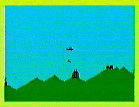 GAME DESCRIPTION
You're piloting a biplane through enemy territory. Drop bombs on factories and ammunition depots. Engage enemy planes in dogfights to the death!
DEVELOPMENT HISTORY
Due to the popularity (especially with APh and Mattel programmers) of the Biplanes game in the Triple Action cartridge, APh proposed this one-player version. A prototype was shown to Mattel with scrolling mountain terrain and targets that could be bombed. The plane graphics, sound effects and flight control were lifted directly from Biplanes. (Enemy planes, which would have presented an artificial intelligence-programming challenge, were not included in the prototype but promised for the finished game.)
Marketing (not as crazy about Biplanes as the programmers) chose not to release the game and it went unfinished.
 FUN FACT: A nice touch is that the second you lose control and smash into the side of a mountain, another biplane flies on-screen, cheerfully circling the crash site, trailing a banner displaying your score.
INTELLIVISION CARTRIDGE [UNFINISHED]
Design/Program: Steve Roney
GAME DESCRIPTION
A puzzle game -- move rows and columns of squares to line up matching colors.
DEVELOPMENT HISTORY
While experimenting with Intellivision graphics, someone in the Design & Development department came up with a kaleidoscopic effect using sequenced GRAM. VP of Applications Software Gabriel Baum liked the effect, dubbed Hypnotic Lights, and asked programmer Steve Roney (Space Spartans) to work it into a game.
Steve's reaction was pretty much: yeah, right, what game? Marketing had a suggestion: something sort of kind of like a Rubik's Cube. That's what Steve sort of kind of gave them. But while Steve continued to tinker with it when not working on higher priority games (including B-17 Bomber, Aquarius Utopia and Space Shuttle), Hypnotic Lights was never elevated to "official" status.
INTELLIVISION CARTRIDGE [UNFINISHED]
Design: Don Daglow
Program: Michelle Mock, Judy Mason
GAME DESCRIPTION
Delay the evil, green monsters from scaling the walls of your building as long as possible, allowing the maximum number of people inside to escape through the roof hatch to the waiting rescue helicopter.
DEVELOPMENT HISTORY
Don Daglow (Utopia) came up with the idea for this humorous arcade-type game in November 1981. By that time he had been promoted to Director; he had no time to do it himself and all of his programmers were on other projects, so the idea was put on hold.
Midway through 1982, Michelle Mock was hired and assigned to Off the Wall. She was less than enthusiastic; a Dungeons & Dragons addict, she wanted to design a fantasy role-playing game. She spent most of her time working on a proposal with fellow D&D fanatics Dan Bass (Loco-Motion) and Bill Goodrich (Quest) for a Keyboard Component-based series of cassettes that would let you use characters you created in a variety of adventures, each to be sold separately at a store near you. (New ideas for the Keyboard Component were not a high priority at this point so the proposal went nowhere.)
When forced back to work on Off the Wall, she developed an introduction screen that put explanatory text on the pages of an open book -- suspiciously more appropriate for a D&D-type game than for what she had been assigned.
When the Keyboard Component was killed late in 1982 in favor of the Entertainment Computer System (ECS), Don suggested that Off the Wall might make a good ECS game. Michelle balked at the idea; the Keyboard Component had gone nowhere, and she suspected that the ECS would suffer a similar fate. She wanted no part of developing a game for what she felt was a dead-end system.
At that point, Don suggested that Michelle might be happier in a different department; she transferred soon thereafter to Design & Development. Apparently, she wasn't happier; she left Mattel a short time later.
When Judy Mason was hired in November 1982, she briefly picked up Off the Wall, although there really wasn't much to pick up. She was quickly reassigned to King of the Mountain, a design idea Marketing was more enthusiastic about. No further work was done on Off the Wall.
INTELLIVISION CARTRIDGE [UNFINISHED]
Produced by APh Technology Consultants for Mattel Electronics
CATALOG DESCRIPTION (of M Network Atari 2600 game AIR RAIDERS)
As the pilot of your bomber, your mission is to blast the enemy out of the sky. Zero in on enemy planes, bank right or left, climb and dive. It's a hit! But be sure to keep track of your fuel and ammo, you may have to land to refuel. (One player.)
DEVELOPMENT HISTORY
Air Raiders was the first game of the M Network Atari 2600 cartridges not based on an Intellivision title. It was a good game, so talk started about doing an Intellivision version to be called Air Battle. (Policy at this point was that the Intellivision and M Network versions of a game were to be released under different names.) There was also talk about doing it as an Intellivision III game. Marketing ultimately decided against doing any Intellivision version, apparently fearful that the game was too close to B-17 Bomber and might cut into the sales of the high-priority Intellivoice cartridge.
There is no evidence that any work on an Intellivision version actually began.
 Grid Shock
INTELLIVISION CARTRIDGE [UNRELEASED]
Design/Program/Graphics/Sound Effects: Andy Sells
DESCRIPTION
An arcade game. Carom your shots against the moving wall to fill in the pattern on the back grid.
DEVELOPMENT HISTORY
This original game by Andy Sells looked great; it had a strong 3-D effect as the moving wall swept back and forth across the screen. But while Andy wanted to continue developing the game, management wanted to take advantage of his musical talents. (Shortly before coming to Mattel, his award-winning song "You Love Love [More Than You Love Me]" was recorded by the English group Buck's Fizz. Ask for it by name.)
Andy was continually assigned to work on music and sound effects for other games, including Shark! Shark! and TRON Solar Sailer. He also co-developed the Intellivision sound development tool, Mr. Sound. Whenever he had a chance he returned to Grid Shock, but the game was never elevated to official status.
While the game never made it onto the Intellivision release schedule, it was demonstrated as part of the Intellivision III product line. This was bogus; when the Intellivision III wasn't ready to be shown at the June 1983 Consumer Electronics Show, regular Intellivision screens with particularly nice graphics were passed off as examples of the forthcoming system. Grid Shock was one of these; color packaging was even printed up for it.
After C.E.S., Andy never had a chance to return to the game. His boss, Manager Russ Haft, left Mattel for Atari; Andy was tapped to take his place. A short time later, Andy, too, left for Atari and Grid Shock was abandoned.
 Thin Ice
INTELLIVISION CARTRIDGE [INTV #4433]
Developed and scheduled to be released by Mattel Electronics, this game was ultimately released by INTV Corp. Credits and production history can be found on the INTV page, here.
 Buzz Bombers
INTELLIVISION CARTRIDGE [#4436]
Design/Program: Mike Breen
Graphics: Monique Lujan-Bakerink, Peggi Decarli
Sound/Music: Bill Goodrich CATALOG DESCRIPTION
You're out to extinguish an angry swarm of honey bees armed with only a spray can of bee repellent. As the bees buzz ever closer, you hit them with a blast of spray to turn them into pieces of honeycomb. The more honeycombs, the more points you score. Don't get stung.
PRODUCTION HISTORY
Marketing was trying to get as many games as possible that were similar to known arcade hits, so when retailers said "Atari has Pac-Man," they could say "We have Lock 'n' Chase," or "Atari has Asteroids," "We have Astrosmash and Space Hawk." Buzz Bombers was put into production as Intellivision's answer to Centipede.
FUN FACT: Marketing had a version of the game prototyped with a RAID can and tried to sell Johnson & Johnson, makers of Raid bug-spray, on a tie-in deal a la Kool-Aid Man . They gave it, according to a memo by Director Don Daglow, a "cool reception."
FUN FACT: The classic tune "Flight of the Bumblebee" is used in the cartridge, but it almost wasn't; the crack Legal Department couldn't track down whether the melody was in the public domain or not. Bill Goodrich (Quest) pointed out that the composer, Nikolai Rimsky-Korsakov, had died in 1908, but Legal still wasn't convinced. Eventually, though, they gave it the green light.
FUN FACT: Buzz Bombers is a one-player game only, a fact that wasn't properly communicated to the Visual Design (packaging) department. Tens of thousands of copies were packed before someone realized the back of the box said "1 or 2 can play." They had to cross it out. Every copy. By hand.
(This was just after Josh Denham "resigned" as President of Mattel Electronics. As part of his resignation deal, he was given an office at Mattel from which he could continue to conduct business [i.e., look for work]. The joke going around was that as another part of the deal, he was in there with a Marks-A-Lot crossing out "1 or 2 can play" on Buzz Bomber boxes.)
 Mission X
INTELLIVISION CARTRIDGE [#4437]
Based on the Data East arcade game
Program: John Tomlinson
Graphics: Karen Nugent, Mark Buczek
Sound Effects: Andy Sells CATALOG DESCRIPTION
You're flying a top secret bombing raid over enemy territory. Your mission: To wipe out the enemy battleships, tanks, artillery guns and bridges that come into view as you sweep over the country. Watch out for enemy flak and gunfire! Touch down and go at it again. Fly during the day, or attempt a dangerous night mission.
PRODUCTION NOTE
An M Network
Atari 2600 version was announced but never completed. APh Technology Consultants started a VIC20 version without authorization, but were informed by VP Gabriel Baum that (a) Mattel hadn't decided to do VIC20 releases and (b) if they did, Mission X would not be included.
 EASTER EGG: Press 6 on the right hand controller, 9 on the left and hit RESET to bring up programmer John Tomlinson's name on the title screen.
 Loco-Motion
INTELLIVISION CARTRIDGE [#4438]
Based on the Konami arcade game
Program: Daniel Bass
Track layouts: Dan Bass, Mark Buchignani
Graphics: Dan Bass, Joe Ferreira
Music/Sound Effects: Andy Sells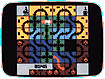 CATALOG DESCRIPTION
An exciting version of the popular Loco-Motion arcade game. You're the engineer deftly guiding your train through scrambled track. You must put the right tracks together to help the train continue safely on its way to pick up passengers. And, you must avoid the crazy train! Non-stop fun as you race to beat the time schedule.
DEVELOPMENT HISTORY
With Atari having most of the good arcade games sewn up, Mattel had to compete with other video game manufacturers for whatever was left over. Upon seeing the Konami arcade game Loco-Motion (one was moved into the Applications Software department in Summer 1982), the programmers and Marketing felt this was a great game for an Intellivision conversion -- it was fun, unique, and "doable" with our technology.
Marketing shelled out big cash to beat out some other bidders for the rights and Ray Kaestner was chosen to do the conversion. Ray was set to take two weeks of vacation in August, so he was scheduled to begin work on Loco-Motion upon his return.
But Dan Bass, who was working on the ECS game Wall Street at the time, became addicted to the Loco-Motion arcade machine and decided he had to do the Intellivision version. Not knowing that Ray had already been picked for the job, Dan set out to get it. In about a week, he secretly put together a demo of the game mechanism, then presented it to management.
Based on the quality of the demo, Dan was pulled off of Wall Street and given the higher-priority Loco-Motion. Ray Kaestner returned from vacation to find that he was off the game. VP Gabriel Baum and Director Don Daglow (Utopia) apologized to Ray and gave him a consolation prize: the job of converting the arcade game BurgerTime.
Everyone was excited about Loco-Motion and Marketing was prepared for a big advertising campaign. Then, just as Loco-Motion was going to ROM manufacturing (a three-month process), Activision released an Intellivision game called Happy Trails.
As far as most people at Konami and Mattel were concerned, Happy Trails was a blatant rip-off of Loco-Motion, actionably so. The programmers and Marketing personnel happily anticipated a lawsuit that would shut Activision down. But no lawsuit was ever filed. Why not?
A Mattel lawyer claimed the problem was that Konami and Mattel couldn't agree on who should file (and pay) for the suit. Mattel felt that since Konami owned the game, Konami should sue. Konami's position, according to the lawyer, was that essentially Mattel was the damaged party (Konami got a huge guaranteed royalty whether the game sold or not); it was Mattel's responsibility to sue.
So no one sued, and Activision got credit for their "originality" in the overwhelmingly good reviews Happy Trails received. Marketing dropped plans for the big push on Loco-Motion, and got rid of the large number of ROMs that had been ordered by discount pricing the cartridge.
An M Network Atari 2600 version was in development but never released.
 Thunder Castle
INTELLIVISION CARTRIDGE [INTV #4469]
Developed and scheduled to be released by Mattel Electronics, this game was ultimately released by INTV Corporation. Credits and production history can be found on the INTV page, here.
INTELLIVISION CARTRIDGE [UNRELEASED]
Produced by APh Technology Consultants for Mattel Electronics
Based on the movie TRON by Walt Disney Productions
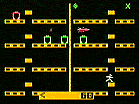 CATALOG DESCRIPTION (for the M Network Atari 2600 version)
Outwit a complex master control program that sends out recognizers, grid bugs and cannon firing tanks in an attempt to destroy you! It'll take strategy, quick reflexes and a cool head to survive. Based on the movie TRON by Walt Disney Productions. (One player.)
DEVELOPMENT HISTORY
APh did this conversion of their original M Network Atari 2600 game without the prior knowledge of Mattel management. Mattel paid for it ($27,000) but ultimately chose not to release it because of the weak performance of the movie TRON.
 FUN FACT: The graphics for the game itself are rather pedestrian, being a faithful copy of the Atari 2600 version, but the title screen is terrific. Using routines developed for the Intellivision III Exec, the screen has a background of cycling colored bands that radiate from the center at hypnotically high-speed.
 BurgerTime
INTELLIVISION CARTRIDGE [#4549]
Based on the Data East arcade game
Program: Ray Kaestner
Graphics: Karen Nugent
Music/Sound Effects: Bill Goodrich CATALOG DESCRIPTION
As the burger chef, you're out to build delicious hamburgers. As you run through the colorful maze assembling the ingredients, nothing can stop you. Except menacing hot dogs and pickles that are out to ruin the meal! Bury them under beef patties, lettuce and buns. Or, knock them out with pepper. Build four burgers and you're on to the next level.
 DEVELOPMENT HISTORY
Returning from vacation in August 1982 thinking he was going to start the Loco-Motion conversion, Ray Kaestner discovered he was going to do the BurgerTime conversion, instead. Scheduled to get married in December, Ray was determined to finish the job within three months so he wouldn't have to worry about deadlines and debugging during wedding preparations.
Three months was a tight schedule; Ray did it in two, a record for an Intellivision game in the Hawthorne office. The extra month gave him a chance to tinker with the timing of the game to get it just the way he wanted. (He didn't escape the game on his wedding day, though -- the groomsmen were playing it while waiting for the ceremony to begin.)
Data East did not have wide distribution for their arcade games, which had hurt when the Intellivision version of Lock 'N' Chase came out -- the name wasn't exactly a household word. But BurgerTime was so good that arcade giant Bally Midway licensed it and got the game into every arcade in America. Mattel had lucked out; it finally had the license to a hit game.
Marketing ordered BurgerTime ported to every system possible (to "all flavors"). M Network Atari 2600, IBM PC and handheld versions were released. Apple and Aquarius versions were also developed. A Commodore translation was ordered but never started. A Colecovision version, done at the Mattel Electronics French programming division, was eventually purchased and released by Coleco. (A later version for the original Nintendo system was unrelated to Mattel Electronics.)
BurgerTime was the first Intellivision cartridge not released as part of a game "network," although the box color, burgundy, matching that of Vectron, indicates that it was originally intended to be part of the Arcade Network. BurgerTime was initially released in the same style boxes of the game networks -- the covers opened like a book. Later copies of BurgerTime were sold in the cheaper, slightly shorter, end-opening boxes used for all subsequent cartridge releases.
The popularity of BurgerTime was such that a sequel, PizzaTime, was ordered by Marketing. (Mattel Electronics was closed before programming could begin.) A different sequel, Diner, was released by INTV Corporation.
FUN FACT: Many people ask why one of the bad guys in BurgerTime is an egg. The arcade game was developed in Japan where many fast-food restaurants give the popular option of adding a fried egg to your burger.
FUN FACT: The television commercial for BurgerTime was the first non- Plimpton ad to focus on one game. In it, two teenagers drive up to a burger stand in which the chef is being chased around the kitchen by giant hot dogs. One of the hot dogs (an actor in a foam-rubber costume with only his red-painted face showing) slams the drive-up window while sneering into the camera "We are CLOSED now!" These prophetic words were repeated many times by the programmers as they packed up their personal belongings a few months later.
FUN FACT: BurgerTime benefited from the demise of the Aquarius Home Computer System. Mattel Electronics had bought considerable television time and magazine space to advertise Aquarius during fall and winter 1983. When the Aquarius was quickly killed by Mattel, the rest of the reserved advertising was switched mostly to commercials for BurgerTime.
INTELLIVISION CARTRIDGE [#4552/UNFINISHED]
AKA: XIV Winter Olympics
Design/Program: Chris Markle
PRODUCTION HISTORY
Mattel Electronics paid millions of dollars to produce the official videogame of the 1984 Winter Olympics. Chris Markle was assigned to the project. He started sketching up ideas for a toboggan run and ski jump, but Chris left Mattel before any programming began.
This was a case where the ball was definitely dropped. After Chris left, no one else was assigned to the game. With millions of dollars invested, no one seemed to notice or care that no Winter Olympics cartridge was actually being developed.
Well, someone did notice, finally, but by that time it was too late to develop an original game. In its place, a multi-game album cartridge of previously-released Sports Network titles was rushed into production (Go For the Gold), and the lead character in Duncan's Thin Ice was changed to the 1984 Winter Olympic mascot, Voochko the Wolf. Mattel Electronics was closed before either cartridge could be released.
INTELLIVISION CARTRIDGE [#4601/UNRELEASED]
Characters used under license of P.A.T. Ward, Inc.
Program: Minh Chau Tran
Music/Sound effects: David Warhol
 CATALOG DESCRIPTION
Rocky and Bullwinkle must stop the evil Boris and Natasha from robbing a train full of priceless valuables. While Boris uses "Upsidasium" to float the valuables up to Natasha's waiting helicopter, Rocky must fly around and intercept them. When Rocky catches the valuables, he gives them to Bullwinkle for safe keeping.
PRODUCTION HISTORY
Minh Chau Tran (Pinball) did this conversion of the M Network Atari 2600 Rocky and Bullwinkle game in just over a month.
Both versions were killed shortly after the management turnover of July 1983.
INTELLIVISION CARTRIDGE [#4602/UNRELEASED]
Working titles: Modern Times, Yogi's Modern Times, Yogi and BooBoo, Yogi's BooBoo, Yogi's Frustration
Characters used under license from Hanna Barbera
Design/Program: Mark Buczek
Graphics: Mark Buczek, Monique Lujan-Bakerink
Music/Sound effects: Joshua Jeffe
 DESCRIPTION
Yogi Bear, fishing from a tree for picnic baskets, accidentally snags Ranger Smith's hat. As punishment, Ranger Smith puts Yogi to work on the Jellystone Park conveyer belt. Help BooBoo get picnic baskets of goodies up to Yogi to keep him working fast.
DEVELOPMENT HISTORY
In 1982, Marketing went on a shopping spree, picking up licenses to dozen of cartoon characters, including the entire Hanna Barbera stable. The royalty agreements included guarantees -- if Mattel Electronics didn't release a game within a year using the characters, Mattel would have to pay a lump sum, averaging around $300,000 per license.
By 1983, realizing they couldn't get original games using the characters into production fast enough, Marketing started looking for games nearing completion that the characters could be dropped into.
Unfortunately for Mark Buczek, Marketing thought his game Modern Times was suitable for the Yogi Bear license. Loosely inspired by the Charlie Chaplin film of the same name, Modern Times was a good game that was almost finished. Suddenly, Mark was having to figure out how to shoehorn Yogi and BooBoo into it.
Months went by as the game was tinkered with, tested and re-tested. Monique Lujan-Bakerink was brought in to add special animated cartoon screens. Still, the game didn't test well and release was held up further.
Ironically, late in 1983, it was noted that the game itself tested fine, it was Yogi and BooBoo that were testing poorly. Marketing decided the game needed new characters. Unfortunately, Mark Buczek had been laid off by this time; no further work was done.
 FUN FACT: When Mattel Electronics closed in 1984, millions were owed in royalty fees on undeveloped licenses -- Yogi and BooBoo, Rocky and Bullwinkle, Woody Woodpecker, Laurel and Hardy, Bozo the Clown...on and on. Roy Ekstrand of the Mattel Legal department speculated that Mattel, Inc. would wind up paying off at about thirty cents on the dollar.
 Kool-Aid Man
INTELLIVISION CARTRIDGE [#4675]
Characters used under license from General Foods Corporation
Design: Vladimir Hrycenko, Mark Kennedy
Program: Mark Kennedy
Graphics: Monique Lujan-Bakerink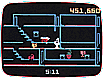 PACKAGE DESCRIPTION
Two children are trapped in a haunted house. A pair of insatiable THIRSTIES roam around trying to catch them! Help the children avoid the dangerous THIRSTIES and collect all the makings for a batch of KOOL-AID soft drink mix. Hooray! KOOL-AID MAN comes to the rescue! From then on -- the THIRSTIES, plus PHANTOM FLAVORS get chased by KOOL-AID MAN!
DEVELOPMENT HISTORY
On December 6, 1982, all of the programmers and graphic artists were herded into a conference room and shown a series of TV commercials -- the new Kool-Aid ad campaign. It was announced that Marketing had made a tie-in deal to release Intellivision and M Network Atari 2600 Kool-Aid Man cartridges. The games were scheduled to be ready in about 6 months, which meant that programming had to begin immediately. Worse, they wanted game-screen mockups to appear in the 1983 Mattel Electronics catalog at the Consumer Electronics Show -- one month away. A two-week contest to come up with the best game concept was announced. Separate ideas were developed for Intellivision and Atari 2600.
This led to a confrontation with Marketing. The programmers' viewpoint was that the features of a game should be tailored to the system it would be played on, to take full advantage of the system's strengths. Marketing, on the other hand, wanted games designed for multiple systems, with the features being the same on each system. If a game couldn't be ported to other systems, it shouldn't be done on any system.
The programmers argued that this meant all games would have to be designed for the lowest common denominator -- the Atari 2600. Marketing argued that keeping the features the same would make games easier to advertise and make word-of-mouth among customers more favorable.
This was the programmers' chance to make a stand, insisting that because of the tight schedule, the Intellivision and Atari versions of Kool-Aid Man would have to be developed independently and differently -- there was no time to create a design that could be implemented on both systems.
Reluctantly, Marketing agreed, and two entirely different versions of Kool-Aid Man were developed, designed to take best advantage of each system. The winning design for the Intellivision version came from programmer Vladimir Hrycenko (Convoy). Steve Tatsumi did the design and program for Atari Kool-Aid Man.
Programming won the battle, but Marketing won the war -- they never again allowed different versions of a game tailored for different systems.
And, well, it looks like they were right. To this day, people still seem upset that the two Kool-Aid Man games are different. Go figure.
FUN FACT: "And please, no 'Jonestown' references," admonished manager Russ Haft (TRON Maze-A-Tron) upon announcing the contest for game ideas. He was trying to stem the inevitable suggestions that would revolve around the 1979 mass suicide via cyanide-laced-grape-Kool-Aid of Jim Jones and his religious followers in Guyana. Some people at Mattel feared that sick, juvenile jokes made by the programmers might get back to the Kool-Aid folks and screw up the deal. Of course, the only people who feared that were the people who actually knew us.
FUN FACT: Reportedly, General Foods was delighted with the games and the response to the special promotion, and expressed an interest in a Kool-Aid Man II project. But at the time (July, August, 1983) Mattel Electronics was dealing with a massive layoff and management restructuring, and Kool-Aid Man II apparently got lost in the shuffle.
FUN FACT: One magazine dubbed Kool-Aid Man as the "stupidest video game of 1983," adding "What's next, the Michelin Man game?"As a result, to this day when someone refers to Kool-Aid Man, Mark Kennedy corrects them with, "that's the AWARD-WINNING Kool-Aid Man!"
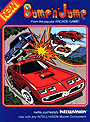 Bump 'N' Jump
INTELLIVISION CARTRIDGE [#4688]
Produced by Technology Associates for Mattel Electronics
Based on the Data East arcade game
Program/Graphics/Sound Effects/Music: Joe Jacobs and Dennis Clark
Title screen graphics: Daisy Nguyen CATALOG DESCRIPTION
The wackiest thing to happen to driving since rush hour! You're racing down a highway, but there's a traffic jam up ahead. You can bump the cars out of the way, or jump them to score points. But slow drivers aren't the only hazards on the road! You must jump over water, and debris dropped in your path by dumptrucks. And beware of the reckless driver! Get out of enough jams and you can stop at the gas station for a fill-up.
DEVELOPMENT HISTORY
One day, Mattel Electronics was contacted by a couple of guys from New Jersey, Joe Jacobs and Dennis Clark, with startling information: they had hooked up a PlayCable unit to a personal computer and made their own Intellivision development system. They demonstrated that they had figured out how to program Intellivision games quite well, and they wanted to offer their services to Mattel before going to some other company. Ah, blackmail is such an ugly word...
To keep them away from the competition, Mattel contracted with them to program the Intellivision version of the arcade game Bump 'N' Jump. They, under the name Technology Associates, were paid $24,000 for the conversion.
David Warhol (Mind Strike) served as liaison, giving technical assistance as needed. Except for the title screen graphics by Daisy Nguyen, all the work was done in New Jersey, in one of the programmers' basements; they weren't invited to Mattel headquarters.
An M Network Atari 2600 version was also released. An Aquarius version was announced, but not released.
FUN FACT: Bump 'N' Jump was released just after credits began appearing on boxes (the first was Masters of the Universe: The Power of He-Man). But since policy forbid including names of people not currently employed at Mattel Electronics, no programmers are credited on the packaging and Daisy is given sole credit for graphics. Dave and Andy Sells (Daisy's supervisor) share credits as "Project Coordinators" and the design is credited to Data East USA, Inc.
 Masters of the Universe:
INTELLIVISION CARTRIDGE [#4689]
Characters used under license from Mattel Toys
Program: Rick Koenig, Ray Kaestner
Graphics: Connie Goldman
Music/Sound effects: Joshua Jeffe PACKAGE DESCRIPTION
Fly HE-MAN in his WIND RAIDER on a hair-raising dash in pursuit of SKELETOR. Avoid running out of fuel as you outmaneuver, bomb or blast away the fireballs coming at you -- while bombing SKELETOR on the ground below. If you get HE-MAN near enough to CASTLE GRAYSKULL he fights on foot with just his shield -- through lightning-balls, power-bolts and magic swords -- to get at SKELETOR!
DEVELOPMENT HISTORY
Masters of the Universe -- a series of action figures tied in to an afternoon animated series -- was a smash hit for Mattel Toys, its biggest success in years. Getting Intellivision and Atari 2600 video games out for Christmas 1983 was a priority.
Wanting to avoid what happened with Kool-Aid Man, Marketing decreed that the two versions should be the same. A two-phase game was agreed on -- flying the Wind Raider to Castle Grayskull; battling Skeletor inside the castle -- with different programmers doing each phase to speed production. In February 1983, work started on the Intellivision version.
Rick Koenig (Motocross) was chosen to do the Wind Raider phase and Vladimir Hrycenko was pulled off the lower-priority Convoy to do the Castle Grayskull phase.
By the end of April, it became apparent that the Castle Grayskull section wasn't coming together. Vladimir was replaced with Ray Kaestner (BurgerTime) who was at the time experimenting with ideas for a proposed Intellivision III version of Night Stalker. Ray scrapped all of Vladimir's existing code and started from scratch with the deadline only four weeks away. Using some fancy graphics-handling routines that he had developed for the Intellivision III, Ray met the deadline.
When the game came out (on schedule) it did well, so Rick and Ray were put to work on Masters of the Universe II. It was unfinished when Mattel Electronics was closed in January 1984; Ray's part of the game eventually became the INTV Corporation release Diner, a sequel to BurgerTime.
A Colecovision version of Masters of the Universe: The Power of He-Man was completed but was unreleased when Mattel Electronics closed.
FUN FACT: The Intellivision III routines that Ray used and the special graphics routines Rick independently developed for the game -- all of which bypassed the EXEC -- moved objects on screen smoother and faster than in standard Intellivision games. Marketing dubbed this improved look SuperGraphics, hoping it would help in the competition with the higher resolution Colecovision. While Masters of the Universe was the first (and only) game to carry the SuperGraphics logo on the box, Marketing liked the designation so much they started using it even before Masters came out to promote any game -- beginning with BurgerTime -- that simply had nice graphics and animation. At the June 1983 Consumer Electronics Show in Chicago, nearly every Intellivision game on display -- Buzz Bombers, Thin Ice, Mission X -- carried the SuperGraphics logo.
FUN FACT: At the beginning of the video game boom, Mattel Electronics worked hard to keep the names of its programmers secret, for fear Atari, Imagic or Activision would lure them away. But by 1983, this secrecy was pretty much meaningless -- headhunters had learned the identities of every company's roster (often bribing employees hundreds of dollars for copies of internal phone lists). Sure that everyone knew their identities but the public, and rankled by Activision's publicizing of their designers, the Blue Sky Rangers started pushing for names on cartridges.
The cause was helped by an editorial in the June 1983 Electronic Games magazine, written by Arnie Katz, which called upon the game companies to reveal the programmers: "All designers of electronic games are just as much creative artists as painters and novelists...Why shouldn't the creator of such a work of art be entitled to put his or her name on it to reap the praise and brickbats of gaming consumers?"
Copies of the editorial appeared throughout Applications Software pinned to programmers' cubicles. More importantly, on May 11, a few days after the magazine had hit the newsstands, VP Gabriel Baum forwarded a copy to the Senior Vice Presidents, with a brief note supporting it: "The names of our key personnel are available to any investigative headhunter and I believe that we are more likely to retain employees than to lose them by publicly recognizing their connection with a cartridge. I also believe that our Marketing group could use programmer/designer recognition to their advantage."
On May 27, Mattel Electronics announced credits would appear on future game packages.
Masters of the Universe: The Power of He-Man, the Intellivision and M Network Atari 2600 versions, were the first cartridges in which the design teams received credit on the packaging. The Intellivision box lists Ray, Rick, Connie and Josh, plus "Project Coordinator" (what today would be called Producer) Mark Urbaniec (Vectron).
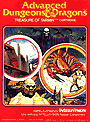 ADVANCED DUNGEONS & DRAGONS TREASURE OF TARMIN Cartridge
INTELLIVISION CARTRIDGE [#5300]
Trademarks owned by and used under license from TSR Hobbies, Inc.
AKA: Minotaur (working title), D&D II, Treasure of Tarmin
Produced by APh Technology Consultants for Mattel Electronics
Program: Tom Loughry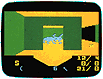 CATALOG DESCRIPTION
You've found the secret map to the underground lair of the dreaded Minotaur. You can go in, but you'll never come out unless you slay the Minotaur and claim his Tarmin treasure. As you make your way through the hallways and chambers, monsters wield their conventional or spiritual weapons. You must gather the proper defenses along the way. But use them sparingly, the Minotaur looms closer!
DEVELOPMENT HISTORY
ADVANCED DUNGEONS & DRAGONS TREASURE OF TARMIN Cartridge was in production at APh since 1981. At the beginning, APh hoped to do two versions: an Intellivision cartridge, and an enhanced version for the original Keyboard Component, featuring synchronized voices. The Keyboard version was never started.
FUN FACT: As with ADVANCED DUNGEONS & DRAGONS CLOUDY MOUNTAIN Cartridge, the capitalization and inclusion of the word "Cartridge" are contractually part of the title of ADVANCED DUNGEONS & DRAGONS TREASURE OF TARMIN Cartridge at TSR's insistence.
FUN FACT: TSR insisted on so much legal lingo on the title screen, there was no room for the title Treasure of Tarmin. The title screen identifies the game simply as ADVANCED DUNGEONS & DRAGONS Cartridge, same as on the ADVANCED DUNGEONS & DRAGONS CLOUDY MOUNTAIN Cartridge title screen.
FUN FACT: Programmer Tom Loughry later designed The Dreadnaught Factor and Worm Whomper Intellivision cartridges for Activision.
 World Championship Baseball
INTELLIVISION CARTRIDGE [INTV #5789]
Developed and scheduled to be released by Mattel Electronics, this game was ultimately released by INTV Corp. Credits and production history can be found on the INTV page, here.
INTELLIVISION CARTRIDGE [UNFINISHED]
Produced by APh Technology Consultants for Mattel Electronics
Program: Scott Bishop
(An enhanced version of the previously released NBA Basketball)
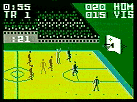 DESCRIPTION
Basketball for one or two players. Scrolling screen for more than twice the playing area of the NBA Basketball cartridge. 4 on-screen players per team (as opposed to 3 for NBA Basketball).
DEVELOPMENT HISTORY
This enhanced one- or two-player version of NBA Basketball was started in 1981 along with Baseball II as part of the next generation of Intellivision sports titles. It was briefly considered as an Intellivision III title, but work was suspended late in 1982 when Marketing decided that the next generation of sports titles would be for the new Entertainment Computer System, but that basketball would not be among the first games done (baseball, football, soccer and tennis were).
During 1982, while video game companies weren't really paying attention, the video game fad ended. Teenagers switched their televisions to MTV; adults got hooked on the board game Trivial Pursuit. But more and more companies announced new titles for Atari, Intellivision and Colecovision.
Millions of games were on store shelves for Christmas 1982, but as 1983 started, retailers started returning millions of them unsold.
Thanks to a market of hardcore players, the demand for video games was still growing, but at a much slower rate than the manufacturers were churning out new cartridges.
Because they failed to keep up with this evolving marketplace, Mattel Electronics' top management was replaced in July 1983. Due to the development and manufacturing time for a game -- six months minimum, realistically around a year -- there was little effect on the 1983 product line, but the strategy for 1984 was radically different.
Fewer titles were to be released. Every title had to be produced for multiple systems to make marketing and advertising more efficient. M Network titles had already been released for Atari 2600, IBM PC and the Apple II. Adding ColecoVision, Commodore 64 and other computers was planned.
Most titles were also required to have a licensing tie-in: an arcade game, a movie, a television show. A title would be released without a tie-in only if it had some feature or effect so innovative that marketing could build promotion of the game around that feature (for example, the 3-D glasses of Hover Force 3-D).
ALBUM CARTRIDGES
Also planned for 1984 was discontinuing the early Intellivision cartridges. Instead, the old 4K games were to have been bundled into 36K multi-game "albums" as new technology and falling ROM prices made larger cartridges possible.
Except for Go For The Gold (which recycled four Sports Network games in an Olympics-themed cartridge) and Party Line (which would have included three original games), no album cartridges were announced. But dozens of different combinations were proposed.
Most of these proposed albums were obvious -- sports games, action games -- but several interesting ideas came up. One was to use canceled or marginal (in Marketing's viewpoint) games so that one new title could be included on each cartridge (using Thin Ice to anchor a children's album was briefly considered). Another was to include the Intellivoice game Space Spartans on a space album, since it was only 8K, could be played at lower levels without voice, and might spark some sales of Intellivoice modules, which were gathering dust on store shelves.
Who knows? -- Hypnotic Lights, Magic Carousel, Adventures of TRON and other shelved titles all might have finally seen the light of day, but Mattel Electronics closed in January 1984, before any album cartridge could be produced.
INTELLIVISION CARTRIDGE [UNFINISHED]
AKA: Moon Corridors
Design: Russ Ludwick, Ron Surratt, Pat Lewis
Program: Russ Ludwick
Graphics: Joe [Ferreira] King
 MARKETING DESCRIPTION
DEVELOPMENT HISTORY
After finishing USCF Chess, Russ Ludwick started work on a game he called Moon Corridors, intended as the Intellivision answer to Battlezone, a popular point-of-view tank game in video arcades. Russ programmed a green grid over which the player could rotate left and right and move forward toward a distant mountainscape.
At the same time, Ron Surratt and Pat Lewis were working on an unrelated original M Network Atari 2600 game called Computer Revenge that also featured movement over a grid.
Marketing was firmly committed to their All-Flavors strategy -- putting the same game onto as many different systems as possible. Spotting a superficial similarity -- the grid -- between Moon Corridors and Computer Revenge, Marketing decided they should be merged into one game: Computer Corridor.
A few discussions were held on what the new unified game should be like, but Russ left the company a short time later. Work continued on the Atari version, but no one was ever assigned to continue the Intellivision version.
INTELLIVISION ALBUM CARTRIDGE [UNFINISHED]
Includes the games Santa's Helper, Easter Eggcitement and Trick or Treat
Design/Program: Dale Lynn
Graphics: Kai Tran, Lori Sunahara
DESCRIPTION
An album of three holiday-themed games:
 Santa's Helper
Find and gather all the toys and gifts. Find the elf for extra points. Get all the gifts and join Santa in his sleigh. Drop gifts down chimneys as they scroll past below the sleigh.
 Easter Eggcitement
Find the Easter eggs hidden in the park. Find the Easter Bunny for extra points.
 Trick or Treat
Go trick-or-treating; get candy from houses where the lights are on. Avoid the witches, ghosts and pumpkins.
DEVELOPMENT HISTORY
As Intellivision games started growing in size, a technical limitation was hit: the Intellivision memory map only allowed for 16K of cartridge space. Some new games on the drawing boards, especially ECS games, required at least 24K.
The Design & Development department worked around the problem by building cartridges using pagable ROM. 4K blocks -- pages -- of data could share the same address space and be selected by the program as needed.
While the pagable ROMs were intended to allow larger games, it was apparent that they would be ideal for multi-game "albums." Several old and/or new games could easily be linked together on one cartridge with a menu.
To demonstrate this, Dale Lynn of the D & D department came up with the original idea Happy Holidays. The cartridge would contain three original holiday-themed games.
Demo screens for the games were designed by Kai Tran and Lori Sunahara, also of D & D, and Dale programmed some simple animation. Dale presented the idea at a meeting of the senior Mattel Electronics executives.
The concept of game albums was enthusiastically embraced: everyone started brainstorming ideas for albums of both original and recycled games. (Many albums probably would have hit the market in 1984, but only two -- Go For the Gold and Party Line -- formally made it onto the release schedule.)
The idea of Happy Holidays itself, however, was quickly squelched by VP of Application Software Gabriel Baum. Gabriel jealously guarded his department as the only one within Mattel to actually develop Intellivision cartridges. At the meeting, he dismissed the idea of a holiday-themed cartridge, declaring there would be no market for it. Case closed. Happy Holidays died on the spot.
(One D & D programmed game did eventually make it to market: Melody Blaster for the ECS Music Synthesizer.)
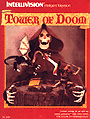 Tower of Doom
INTELLIVISION CARTRIDGE [INTV #8600]
Started at Mattel Electronics as ADVANCED DUNGEONS & DRAGONS TOWER OF MYSTERY Cartridge [#4692]
AKA: D&D III, Arcade D&D, ADVANCED DUNGEONS & DRAGONS REVENGE OF THE MASTER Cartridge
Finished by Realtime Associates for INTV Corp.
Design/Program: Dan Bass, John Tomlinson
Graphics: Monique Lujan-Bakerink, Connie Goldman, Karl Morris
Music/sound effects: David Warhol, Joshua Jeffe
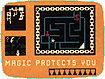 CATALOG DESCRIPTION
Monsters. Magic. Good. Evil. Strength. Cunning. Traps. Mazes. You are about to face the greatest challenge any mortal has ever known -- the Tower of Doom.
For one player
DEVELOPMENT HISTORY
With the success of the first Dungeons & Dragons cartridge, Marketing wanted a continuing series of D&D games. They were a bit concerned that the second release, ADVANCED DUNGEONS & DRAGONS TREASURE OF TARMIN Cartridge, was a bit too complex, so when adding a third D&D game to the schedule, they took to calling it Arcade D&D. "Arcade" was their code word for more action, less brains.
After completing Loco-Motion, Dan Bass took up the challenge of defining what Arcade D&D would be. He designed a screen layout with scrolling text instructions that made the game easy to follow, but would still allow the complex, strategic play that D&D fans expected. Battle scene close-ups provided the action Marketing wanted.
A limited demo of the game appeared at one trade show with the name ADVANCED DUNGEONS & DRAGONS REVENGE OF THE MASTER Cartridge (once again, the bizarre capitalization and inclusion of the word "cartridge" in the title was demanded by contract), but by the time it appeared in Mattel Electronics catalogs it had been renamed ADVANCED DUNGEONS & DRAGONS TOWER OF MYSTERY Cartridge.
The game was only half-completed when Mattel Electronics closed its doors in January 1984. Over two years later, INTV Corp. expressed an interest in releasing it. Dan, working full-time in Massachusetts by this time, was not available to finish it, so John Tomlinson (Mission X) was hired for the job. Connie Goldman (Thunder Castle) completed the graphics started at Mattel by Monique Lujan-Bakerink and Karl Morris.
Not wanting to pay for the Dungeons & Dragons license, INTV released the cartridge in 1987 under the new name, Tower of Doom.
Mattel Electronics had an M Network Atari 2600 version and an Apple version of the game in development when Mattel Electronics closed.
 EASTER EGG: Press 0 (zero) on either hand controller while the title screen is displayed to view game credits.
INTELLIVISION CARTRIDGE [UNFINISHED]
AKA: Star Quest
Design: John Tomlinson, Eric Wels, Jerry Moore
Program: John Tomlinson, Jerry Moore
PROGRAMMERS' DESCRIPTION
The Federation is being invaded by an alien Empire. You must locate and neutralize their forward scout units while the navy prepares to attack the main force. You will be sent on missions to planetary systems of the Federation where you must stabilize the situation. You will go on 12 missions corresponding to the signs of the Zodiac with action relating to the sign characteristics. If you are successful, then you are selected for the Survey Scouts, a great honor.
A survey mission consists of exploring a planet, usually done "in Transfer": your "aura" or "essence of being" is projected into an intelligent lifeform on the planet. You become that creature physically, with all of its positive and negative aspects.
All planets and adventures are randomly generated; if you're not killed by the Empire, space pirates, or angry aliens, you will be able to adventure forever.
DEVELOPMENT HISTORY
Eric Wels and John Tomlinson presented the original idea for the game, then called Star Quest, in a May 6, 1982 memo to their boss, Director Don Daglow (Utopia). They pictured it as a space Dungeons & Dragons.
Marketing had other ideas though: they wanted an Intellivision version of the arcade game Mission X, and John was assigned to do it.
While completing Mission X, John secretly worked on Star Quest. When Mission X was finished, he campaigned to be allowed to continue developing Star Quest, arguing that a substantial portion of it was already done.
His strategy worked. Although feeling the concept was too complicated (it was never put on the official release schedule or assigned a product number), management let John continue, with the caveat he make it more action, less strategy. Eric had left Mattel by this time, so new hire Jerry Moore was assigned to assist on the game, renamed Target Andromeda.
The game was killed in the aftermath of the July 1983 management upheaval.
 Go for the Gold
INTELLIVISION ALBUM CARTRIDGE [#5393/UNRELEASED]
Used under license from OCOG Sarajevo '84
Working Title: Olympics Album
Includes modified versions of the previously released Boxing, U.S. Ski Team Skiing, NHL Hockey and NBA Basketball produced by APH Technology Consultants for Mattel Electronics
Title screen & menu program: Keith Robinson
Title screen graphics: Monique Lujan-Bakerink
Title screen & menu music: David Warhol
 CATALOG DESCRIPTION
Four Intellivision sports hits in a single cartridge makes the "Official videogame of the 1984 Winter Olympics" a winner -- play Skiing, Hockey, Basketball and Boxing.
DEVELOPMENT HISTORY
After Chris Markle, who was working on the official Winter Olympics cartridge, left Mattel Electronics, no one was assigned to continue it. Midway through 1983, Marketing suddenly realized they had spent millions of dollars to obtain the Winter Olympics license, but didn't have a Winter Olympics cartridge.
Salvation came in the form of the multi-game album concept that Design & Development had demonstrated with Happy Holidays. Keith Robinson (TRON Solar Sailer) was assigned the task of slapping together some old sports titles and calling it an Olympics cartridge.
Of the previously released Intellivision Sports Network cartridges, six -- Boxing, NBA Basketball, NASL Soccer, Tennis, U.S. Ski Skiing, NHL Hockey -- were, in their amateur form, Olympic sports, so those were chosen to be in the album. Keith modified their code to remove designations such as HOME and VISITOR from the scores to make them look more like Olympic events.
Monique Lujan-Bakerink animated a runner lighting the Olympic torch for the title screen, and David Warhol composed a fanfare that sounded very close to the familiar Olympic theme.
The game went together very quickly and Marketing was delighted, even though it meant that six sets of hand controllers and an especially thick instruction book would have to go into the package. The boxes were already printed and ROMs were just about to be manufactured when the legal department threw a wrench into the works: Mattel had purchased a license for the 1984 Winter Olympics. They didn't have the rights to the Summer Olympics. Including summer sports on the Go For The Gold cartridge could open Mattel to a lawsuit. Legal demanded the summer sports be removed from the cartridge.
 Keith pointed out that would leave only Skiing and Hockey. Two games made for a pretty poor album. Marketing agreed that the cartridge couldn't be released that way. Keith, his boss Mike Minkoff (Snafu), and Marketing worked out a compromise that Legal thought they might be able to get away with: in addition to Skiing and Hockey, Boxing and Basketball would also be included. That would make half the cartridge winter sports (as opposed to before when it was mostly summer sports) and, since Boxing and Basketball are played indoors, they could be played in winter. (Yes, that was stretching it.)
Keith reworked the cartridge to remove Soccer and Tennis, and new packaging was designed (only a black and white mockup was finished), but Mattel Electronics closed before the game went into manufacturing.
 FUN FACT: As a bonus, each cartridge was to come with an embroidered 1984 Winter Olympics patch. Mattel Electronics purchased tens of thousands of these, with little "GO FOR THE GOLD WITH MATTEL ELECTRONICS" ribbons attached. Mattel employees kept maybe a hundred or so as souvenirs; the rest are probably in a landfill somewhere.
FUN FACT: David Warhol recycled the Go For The Gold fanfare in the INTV Corp. release Super Pro Decathlon.
 Hover Force
INTELLIVISION CARTRIDGE [INTV #8500]
Developed at Mattel Electronics as Hover Force 3-D [#7742]
Completed by Realtime Associates for INTV Corporation
Design: Steve Ettinger, Joe [Ferreira] King, David Warhol
Program: Steve Ettinger
Graphics: Joe King
Sound Effects: David Warhol
 PACKAGE DESCRIPTION
TOP SECRET
TO: HOVER FORCE PILOTS
FROM: COL. N.K. NEWCOMBE
RE: MISSION INSTRUCTIONS
Terrorist helicopter forces have taken over the island city of New Seeburg. Luckily, civilians have been evacuated from the city, but the enemy is causing millions of dollars in damage. Fires are burning out of control throughout the island.
We're sending you in with a heavily armed combat helicopter. Your assignment:
Use RADAR SCREEN to spot and track the enemy! Use LASER CANNONS to blast enemy copters out of the sky! Use WATER CANNONS to put out fires from mid-air! Cover hundreds of square miles ridding the city of terrorists and fires for highest RATING. Aim carefully! Your wild shots can damage the city and lower your rating! Use STRATEGY! There are over 20 different types of enemy copters, each with its own skill level and flight pattern! You need your BRAINS to catch up with them! Fly repeated missions, each more difficult than the one before. One last warning: these guys will be gunning for YOU. And this isn't some game, this is combat. None of this "three lives" foolishness. Crash your copter and it's all over -- you're finished.
So watch your tail out there. Now, let's scramble!
DEVELOPMENT HISTORY
Hover Force 3-D was developed under greater secrecy than any other Mattel game. Researcher Richard Steenblik working at the Georgia Institute of Technology had developed pseudo-3-D glasses. Small prisms in the glasses bent different colors of light entering the eye at different angles, fooling the eye into thinking that, for example, blue objects on a flat surface were actually farther away than red objects on the same surface. Georgia Tech approached several game manufacturers to see if they were interested in the technology. After a middle-of-the-night test session in which Keith Robinson (Solar Sailer) quickly threw together an Intellivision screen full of flying bugs of different colors, Mattel management decided to aggressively pursue an exclusive license for the glasses.
Game development was ordered to start immediately, before the license was secured. For fear that a competitor would find out and try to outbid Mattel, the project was kept top secret, even from the other programmers. It was code named "Peach" since the glasses originated in Georgia, the Peach State. Steve Ettinger and Joe King, who had worked well together on Magic Carousel, were given a locked, windowless office in which to work (the rest of the software staff worked in open cubicles); it was quickly dubbed "The Bat Cave."
Midway through the project, Mattel won the license and Peach emerged from the cave. The 3-D effect, while not eye-poppingly dramatic, was effective, especially given the visual cues Steve and Joe had designed. And Dave "Papa Intellivision" Chandler's group had developed an inexpensive method to manufacture the glasses, making it practical for the game and glasses to be sold together at the price of a normal cartridge. Marketing felt they could strongly promote the 3-D feature in ads and the press.
Hover Force 3-D debuted at the January 1984 Consumer Electronic Show to good response. While the 3-D effect got mixed reviews, everyone was talking about it. Management immediately started talking about putting two more 3-D games into development, including a flight simulator cartridge, but before anything could be started, Mattel Electronics closed.
For the INTV Corp. release of the game in 1986, Steve and producer Dave Warhol beefed up the "intelligence" of the enemy helicopters, adding more strategy to the play. Since the glasses were not included with the game, "3-D" was dropped from the title.
 FUN FACT: The game has three difficulty levels, the middle of which, "RANGER" level, is named in honor of the Blue Sky Rangers.
FUN FACT: The island of New Seeburg derives its name from Steve Ettinger's initials: SEE.
FUN FACT: Joe King was commissioned to do the artwork for the INTV packaging; if the helicopter looks vaguely familiar, it's because he based it on the submarine Nautilus from Disney's film version of 20,000 Leagues Under the Sea. Why? Joe explained, "I make every vehicle I draw look like the Nautilus."
FUN FACT: A recent magazine article reported that Georgia Tech is still trying to find a customer for their 3-D glasses.
 EASTER EGG: Press 0 (zero) on either hand controller while the title screen is displayed to view game credits.
EASTER EGG: Press 23 (two and three simultaneously) on the left hand controller, 26 on the right and press reset to see Steve's message to his wife (born on October 23) and twins (born on November 26).
INTELLIVISION CARTRIDGE [UNFINISHED]
Developed at Nice Ideas (Mattel Electronics, France)
Design/program: Barcay & Burt
Graphics: Bob del Principe
Music/sound effects: Sam Zalan
 PROGRAMMERS' DESCRIPTION
"Well, I'll just give a brief rundown on the situation so that you can appreciate how serious things are." The head of intelligence seems ill at ease, the first time you can remember his icy control wavering.
"The last two agents we sent on this mission -- well, they didn't come back, and you're the only one we have left for the job now. You know about Mr. Andreas Skarfos, alias 'Scarfinger,' of course, and I needn't dwell on the number of times we've run into him before, but this time is different.
"He's seized an island in the Mediterranean and set up a fortress there, equipped with the most sophisticated defenses. He has a number of missiles capable of delivering nuclear warheads to any part of the globe, and unless we answer his demands he will destroy us; only nine minutes are required to arm and launch the warheads.
"His installations are all but invulnerable to surface attack, but we've discovered a slim hope; a tunnel which leads under the island to the reactor which he is using for power. If one man could somehow reach the tunnel and destroy the reactor, we could stop Scarfinger yet!
"To this end, we can equip you with our latest Spycycle, a fully amphibious craft capable of being driven like a motorbike on land, a speedboat in the water, and a minisub undersea. You will have to ride along the cliff road to the island, then across the sea to the tunnel entrance, and finally penetrate the tunnel and destroy the reactor. But as soon as he detects you, Scarfinger will know what is happening, and arm the missiles -- you have only nine minutes for your mission."
As your superior looks at you, something in his glance seems to make you feel that you are the only one he could entrust this to.
"Of course, Scarfinger won't make life easy for you! The road is known to be strewn with land mines, and it is very twisty. Also, recent heavy rains has left large pools of water, and we think that some of the missiles on the island could be fired at the cliffs, causing boulders to tumble onto you.
"In the sea are more mines, and giant mechanical sharks which Scarfinger uses to protect his fortress; also there are many oil slicks from the numerous tankers he has sunk in the area, and these can foul your engines. We believe that some missiles can be used as anti- ship weapons, releasing torpedoes when they hit the water. Your cycle is equipped with a laser rifle and a torpedo launcher for use in this part of your mission.
"For the third part of your task, you will need antimatter bolts, but these are too unstable to last for long, so you will be supplied at sea by a friendly aircraft which drops pods containing the bolts -- you must pick up as many of these as possible to have any chance of destroying the reactor!
"Once in the tunnel, you will face hazards from neutron bolts from the reactor itself, and fire from gun turrets mounted on the tunnel walls -- being hit by either of these will increase your radiation level. You must also avoid the lasers along the sides of the tunnel.
"Once you reach the end of the tunnel, I'm afraid you're on your own; we know very little about how the reactor is constructed. We think there is a gate which you must open, and that within is the reactor core which you must destroy....
"To help you on your mission, we have sophisticated electronic simulators for the first three parts, which you can use as much as you wish to familiarize yourself with the controls. The last part, though, you will have to take as it comes. Good luck!"
DEVELOPMENT HISTORY
Midway through 1983, Mattel Electronics, France sent their first game prototypes to California headquarters for review: Scarfinger, Spina the Bee and Illusions.
Scarfinger was a James Bond-inspired cartridge. The prototype was made up of a series of impressive special-effects laden screens, but no gameplay.
Marketing felt the game was way too complex to effectively produce and market, and that it would be impossible to translate to other systems. They passed.
The programmers deserve points, though, for creative writing.
INTELLIVISION CARTRIDGE [UNFINISHED]
AKA: Zzzz!
Developed at Nice Ideas (Mattel Electronics, France)
Design/program: Simonot
Graphics: Bob del Principe
Music/sound effects: Sam Zalan
 PROGRAMMER'S DESCRIPTION
Gain as much pollen and bonus points as possible without raindrops pushing your bee into the water and without getting blown off the right side of the screen.
DEVELOPMENT HISTORY
Another of the first games developed at the French office, Spina the Bee was based on a European cartoon character, popular with little girls. (Since the rights to Spina had not been obtained, the title Zzzz! was used on the prototypes.)
The French office had been set up to develop games with a European sensibility, but after the Mattel Electronics management change of July 1983 and subsequent programmer layoffs in August, Mattel started to consider the French office simply as a source of programmers to handle the overflow from the California headquarters. The games from France would have to have wide appeal in the United States, as well.
Spina the Bee was judged not to have that wide appeal and was killed.
INTELLIVISION CARTRIDGE [#4743/UNRELEASED]
Working title: Escher
Developed at Nice Ideas (Mattel Electronics, France)
 CATALOG DESCRIPTION
The enchanted mirror splits you into multiple images. You must become whole before time runs out. Changing stairways and folding cubes with SuperGraphics try to keep you from safety.
DEVELOPMENT HISTORY
Of the first game prototypes from the French office, Illusions was the one picked as a winner and given the green light.
The multiple game screens were inspired by the physically impossible designs of Dutch lithographer M.C. Escher (1898 - 1972), hence the working title Escher.
The French office completed both Intellivision and Colecovision versions of Illusions for the January 1984 Consumer Electronics Show. While the Intellivision version was never released, Coleco later bought the rights to and released the Colecovision version.
M Network versions were also planned for the IBM PC Jr. and Commodore 64, but little or no work was done on either.
INTELLIVISION ALBUM CARTRIDGE [#7744/UNRELEASED] Concept: Bill Fisher, Keith Robinson, Andy Sells
Title screen graphics: Monique Lujan-Bakerink
Includes the games:
 BLOW OUT
Working title: Gang Bang
Design: Bill Fisher, Keith Robinson, Andy Sells
Program: Bill Fisher, Mike Breen
Graphics: Keith Robinson
Music/Sound Effects: Andy Sells HARD HAT
Developed at Mattel Electronics, France
Design/program: Grahame Matthews
Graphics: Bob del Principe
Music/Sound Effects: Sam Zalan
 SPACE CADET
Design/Program: Julie Hoshizaki
Graphics: Joe [Ferreira] King, Monique Lujan-Bakerink
Music/Sound Effects: David Warhol, Joshua Jeffe
CATALOG DESCRIPTION
Three new games in one bring new dimensions to home entertainment. Designed for two teams or two players, choose from games featuring rollerskaters, construction workers, or flying saucers.
DEVELOPMENT HISTORY
In November 1982 -- while having lunch at D.B. Levy's Deli in Westwood, California -- Bill Fisher (Space Hawk), Keith Robinson (TRON Solar Sailer) and Andy Sells (Grid Shock) were discussing the high-profile popularity of Trivial Pursuit. News magazines favorably reported on how people across the country were getting together to play the new board game. The solitary (i.e. antisocial) fad of video games, the magazines declared, was dead.
Bill, Keith and Andy wondered, How could video games fight back? They found the answer on the deli menu, where a selection of 3- and 6-foot sandwiches was listed as "The Party Line." How about a series of video games designed to be played at parties? Over lunch, they outlined how the games would work:
Guests at a party would be divided into two teams. The number of players on each team would be entered using the hand controllers. The game would then begin. Two players, one from each team, would compete until a timer ran out, at which point the controllers would be handed off to the next person on each team.
The games would be colorful, simple, and feature loud, nonstop music. Bill, Keith and Andy pictured partiers laughing and cheering while trying to quickly pass the hand controllers back and forth.
Sure they had a winner, they returned from lunch -- an hour or two late -- eager to share their idea with VP of Applications Software Gabriel Baum. They found Gabriel furious -- they had missed an important meeting.
"Ah," he said as they walked in, "when you weren't in the meeting, I assumed that your bloody, broken bodies must lying by the side of the freeway somewhere."
Oops. Recognizing it wasn't the best time to pitch their idea, they decided to prepare a formal presentation with a prototype of one of the games. Working after hours, they put together a fairly complete Party Line game, Gang Bang, later named Blow Out.
February 3, 1983, they filled a conference room with balloons and streamers and presented the game and concept to Gabriel, along with Directors Mike Minkoff (Snafu) and Don Daglow (Utopia). Gabriel loved the idea -- breaking open a bottle of wine in his office to celebrate -- and told Bill, Keith and Andy that they would be making their presentation again to Mattel Electronics President Josh Denham and the senior vice presidents.
The presentation was delayed three months while Keith went to France to train the programmers at the new Mattel Electronics office there, but finally, on May 13, they made their presentation to the senior management.
Bill, Keith and Andy proposed the Party Line as a series of six cartridges, each sold separately. From their presentation:
BLOW OUT
Two roller-skating dancers drop darts from a scaffold onto rising balloons. An easy enough task, except these rude guys keep bumping into each other and knocking each other off the scaffold. When the music stops, that's the signal for the next players to take the controllers.
HIGH DIVE
Teams take turns having their divers jump from the high dive. Controls allow for a forward dive, back flips, and for determining when to come out of the dive. Fancy maneuvers are possible; so are painful belly flops. Three judges hold up cards to tell you how you did.
PARTY ANIMALS
The Party Animals have put on their finest duds and are boogeying over to your house to kick up their heels. Only problem is, these are REAL animals -- moose with wide antlers, kangaroos with long tails, hippos that weigh a ton! Players must keep destruction to a minimum. Game with excellent music potential.
HARD HAT
Each team is building a skyscraper. Between the two structures hangs a platform stacked with bricks. Players must grab bricks for their building without upsetting the platform. Each team can slow down the other -- or themselves, if they're not careful -- by throwing the platform off balance. First team to complete their skyscraper wins.
PUNCH LINE
Yow! Those Party Animals are back -- and they're hungry! Players must keep the punch and cookies coming, or there could be trouble!
SPACE CADET
The looniest space battle ever. Each team is in command of a decrepit flying saucer that seems to work best as a battering ram. It's outer space demolition derby!
President Josh Denham and the other senior staff were enthusiastic about the concept, but instead of six separate games, they decided that the Party Line would be perfect for the new multi-game album concept. Three of the games -- Blow Out, Hard Hat and Space Cadet -- were chosen for the cartridge. The Party Animals would appear on the title screen.
Blow Out was already done. Hard Hat was sent to the French office for programming (in the finished game, bricks were changed to panes of glass which could be knocked off of your opponent's building with a very satisfying crash). Julie Hoshizaki (Thin Ice) did Space Cadet.
The project was delayed in July 1983 when Josh Denham was replaced by Mack Morris. Morris's right-hand man, Jeff Rochlis, didn't like the Party Line, and expressed doubt that there was any market for it. He had Marketing do extensive testing; luckily the results were positive and the cartridge was back on track. An M Network Atari 2600 version of Blow Out was even ordered.
The three games were completed and shown with a title screen by Monique Lujan-Bakerink at the January 1984 Consumer Electronic Show. They were well received, but Mattel Electronics closed two weeks later.
Despite the fact that the games were done, INTV Corp. chose not to release them. For the post-crash market, INTV President Terry Valeski felt only one-player games were viable.
INTELLIVISION CARTRIDGE [#7841/UNFINISHED]
AKA: Super Masters!
Design/program: Ray Kaestner, Rick Koenig
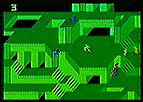 DESCRIPTION
He-Man returns to battle Skeletor in another cartridge based on Mattel's Masters of the Universe action figures.
DEVELOPMENT HISTORY
With the success of Masters of the Universe: The Power of He-Man, Marketing scheduled a sequel. Once again, the game would be in two parts, with one part assigned to Ray Kaestner and one to Rick Koenig. Ray and Rick developed some game screens using fancy new Intellivision effects, but no final name or plot for the game was agreed upon before Mattel Electronics closed. (Asked recently to describe his half of the game, Ray shrugged and replied "He-Man ran around fighting guys.")
M Network versions were also scheduled for Atari 2600 and Colecovision, but little or no work was done on either.
FUN FACT: The screens Ray developed for Masters of the Universe II -- He- Man fighting bad guys on a multilevel 3-D game field with moving walls -- didn't go to waste; he recycled them in the INTV Corp. release Diner, a sequel to his game BurgerTime.
INTELLIVISION CARTRIDGE [#7842/UNFINISHED]
Demo designed and programmed by Steve Roney
DEVELOPMENT HISTORY
Experimenting, Steve Roney (Space Spartans) created a simple but effective Intellivision effect of moving a spotlight around a black screen to "illuminate" a small portion of a maze or other background.
Steve didn't have a game design in mind, but Marketing liked the effect. After checking with the Atari 2600 programmers that the same effect could be duplicated on that system, they ordered a game using the effect be developed for both Intellivision and Atari.
Despite the game being assigned a production number and entered on the schedule, no programmer was attached to the project and no actual work was done beyond Steve's initial demo.
(By this time, November - December 1983, people started to realize that Mattel Electronics would likely close soon. Marketing and management were pretty much going through the motions of scheduling and following through on game designs. A number of games, especially M Network titles, were casually added to the schedule without any programmer being assigned, or even being available.)
M Network versions were also scheduled for Atari 2600, Colecovision, and IBM PC Jr., but no work was done on these.
INTELLIVISION CARTRIDGE [#7843/UNFINISHED]
AKA: French Fries
Developed at Nice Ideas (Mattel Electronics, France)
DESCRIPTION
Peter Pepper, the chef from BurgerTime, returns to make pizzas.
DEVELOPMENT HISTORY
With the success of BurgerTime, Marketing ordered up a sequel. With Ray Kaestner working on Masters of the Universe II, the game was sent to Mattel Electronics, France for development. (The Colecovision version of BurgerTime had been programmed at the French office.)
Jokingly called French Fries at first, the game was officially named once a pizza theme was decided upon. There was little time for actual work on the game, though, before Mattel Electronics closed.
M Network versions were also scheduled for Colecovision, IBM PC Jr., and Commodore 64, but no work was done on these.
INTELLIVISION CARTRIDGE [#7844/UNFINISHED]
Developed at Nice Ideas (Mattel Electronics, France)
DESCRIPTION
Pilot a magic flying carpet.
DEVELOPMENT HISTORY
Another original idea from the French office, this title appears to have been added to the schedule based on a written proposal; a prototype of the game was never seen at Mattel Electronics' California headquarters.
M Network versions were scheduled for Colecovision, IBM PC Jr., and Commodore 64, but no work was done on these.
INTELLIVISION CARTRIDGE [#7845/UNFINISHED]
AKA: Speedboat
Design/program/sound effects: Joshua Jeffe
Graphics: Joe [Ferreira] King
DESCRIPTION
A point-of-view speedboat race.
DEVELOPMENT HISTORY
Josh and Joe put together an impressive demo of the point-of-view effect, racing over a lake. But Hydroplane was mostly memorable for the high-decibel shouting matches Josh and Joe got into over the design of the game. Very little was done before Mattel Electronics closed.
An M Network Atari 2600 version and a Colecovision version were planned, but little work was done on the former and none on the latter.