Activision
Titles for Intellivision
ACTIVISION GAMES FOR INTELLIVISION
 In 1979, Activision was founded to produce titles
for the Atari 2600, becoming the first of the video game
third-party publishers. It was also the first to aggressively raid its
competitors for programmers. After Mattel Electronics introduced
Intellivision in 1980, Activision sought out experienced
programmers from APh
Technology Consulting and Mattel to work on Intellivision
games. In 1979, Activision was founded to produce titles
for the Atari 2600, becoming the first of the video game
third-party publishers. It was also the first to aggressively raid its
competitors for programmers. After Mattel Electronics introduced
Intellivision in 1980, Activision sought out experienced
programmers from APh
Technology Consulting and Mattel to work on Intellivision
games.
Peter Kaminski was recruited from APh; at Activision he
programmed Intellivision
River Raid. John Sohl and Steve Montero joined
Activision after designing games at Mattel. (Ironically, neither completed
an Intellivision title before Activision pulled the plug on Intellivision
development in 1983.)
But Activision's biggest recruitment coup came when the senior
programmers at APh left to form their own company, Cheshire
Engineering. Activision was the highest bidder in securing
Cheshire's services to create original Intellivision games (Activision's
in-house Intellivision titles were conversions of Atari 2600 games).
Cheshire designed six original games for Intellivision: Beamrider,
The
Dreadnaught Factor, Worm
Whomper, Cloud
Nine, RocketBall
and Towerquest.
The first three of these were released; the second three were switched
late 1983 from Intellivision to Colecovision before being abandoned
in 1984 cutbacks.
To avoid a lawsuit for stealing corporate secrets, Activision
was careful to demonstrate that it already had the knowledge to program
for Intellivision (through reverse-engineering) before hiring anyone from
APh or Mattel. The former APh and Mattel programmers were told that they
were being hired only for their experience, not their knowledge. In other
words, they couldn't use any features of the operating system (the Exec)
that Activision didn't specifically know and tell them about.
This was particularly ironic for David Rolfe of Cheshire.
At APh, Dave wrote the Exec; now he had to feign ignorance of what
it did. He poked fun at this in his code for Beamrider.
In copying Activision's instructions for setting up the initial game
parameters, he commented the code with notes such as "The following
instructions do magic things" and "I wonder what THIS does" and simply
"?????".
Without the overhead of hardware production and game
licenses like Atari, Mattel Electronics and Coleco
were committed to, Activision was in a better position to weather the
industry crash of late 1983. In fact, after Mattel Electronics closed,
several of the Blue Sky
Rangers were hired by Activision. Activision also acquired rival
third-party publisher Imagic.
Even Activision had to scale back dramatically as the industry
continued to drop in 1984. All console titles were cancelled in favor of
computer games exclusively. Activision managed to survive the lean years
of the late 1980s. And with the resurgence of video games and growth of
computer games in the 1990s, Activision reemerged as a major
publisher.
In 1998, Activision came full circle, releasing Activision
Classics - a PlayStation collection of its original Atari
2600 games.
In 1999, Activision made a deal with Intellivision
Productions, Inc. to release the Mattel Electronics/INTV
library of games on its Intellivision
Classics collection for PlayStation. In the same
agreement, Intellivision Productions acquired the Activision and
Imagic libraries to release on its October 2000 Intellivision
Rocks! collection for Windows and Mac.
 FUN FACT:
David Rolfe (Beamrider)
shares this anecdote: FUN FACT:
David Rolfe (Beamrider)
shares this anecdote:
"At Cheshire
Engineering we made a deal in late 1982 to produce games for
Activision. We attended C.E.S. in January of 1983 (Las
Vegas) as guests of Activision. Their most current release was Dave
Crane's 'Decathlon,' and this was heavily promoted - in fact, I still
have a flashy promotional jacket.
"You may recall that the Decathlon game involved guiding the screen
figure through a series of athletic events. You advanced him by wiggling
the Atari 2600 joystick back and forth as rapidly as possible. This
was an unusual thing to do with a joystick, and users found the most
effective way to achieve maximum motion was to sit on a chair and hold the
base of the joystick firmly between their thighs, and then to hold the
joystick itself with their hands for the purpose of wiggling it.
"I remember walking into the Activision hospitality suite and seeing a
roomful of people trying the game. At first glance, the view was rather
disturbing: A cluster of guys, seated, staring intently at a TV monitor,
hands firmly grasping a protrusion at the crotch area, wiggling furiously.
I recall saying to the Cheshire person I walked in with, in mock shock,
'What the hell's going on in here, anyway?' He shot back, 'Nothing
much...just a bunch of geeks playing, ah, Dick-athlon.'"
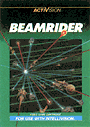 Beamrider Beamrider
INTELLIVISION
CARTRIDGE [ACTIVISION #M-005]
Produced by Cheshire
Engineering for Activision
Design/Program: David
Rolfe
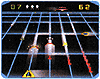 CATALOG DESCRIPTION (Fall/Winter 1983) CATALOG DESCRIPTION (Fall/Winter 1983)
An
impenetrable shield of light, 99 sectors deep, is encompassing the planet.
You, alone, must cruise from beam to beam, casting lariats of laser bolts
into white saucers, red zig bombs, yellow chirpers and more! The quest: to
penetrate the shield and restore space exploration to the planet. You have
the skill! You have the daring! You are Beamrider!
DEVELOPMENT
HISTORY
Beamrider was an original Intellivision
game programmed at Cheshire
Engineering under contract to Activision. Inspiration for the game
came to David Rolfe one day as he was leaning back in his chair
staring at the ceiling. Suddenly the receding grid of acoustical tiles
became an outer space playing field.
Activision later released versions of Beamrider for Atari
2600, Atari 5200 and ColecoVision.
 PLAYING
TIPS: From designer Dave Rolfe in the
Beamrider instruction manual: PLAYING
TIPS: From designer Dave Rolfe in the
Beamrider instruction manual:
"Greetings from sector 26 and moving! If you want to make it to the
outer sectors, pay attention to these tips.
"First of all, don't hold down the disc. Maintain precise control by
learning to TAP the disc to move a single beam at a time. And stay near
the center beams so you won't get boxed into a corner with nowhere to
run.
"Zap the white enemy saucers as early in their approach as possible.
And check this out: You can hit them when they're slightly off the beam,
before they can drop their missiles.
"When you see a yellow rejuvenator, don't abandon all caution as you
move to catch it, or you'll likely wreck your ship. If an invulnerable
object is blocking it, you can use a torpedo to blast it out of the way.
Then, catch the rejuvenator. But remember, you only have three torpedoes
and they're your only weapon against the Sector Sentinel.
"And while we're on the subject, when the Sentinel is about to
approach, don't sit on the beam you plan to shoot from. Green Blockers
will swarm onto it immediately! Instead, wait on a beam you're not going
to shoot from (like the one nearest the Sentinel's first sighting). As
soon as the Blockers are 'locked' onto that beam, zip over to an unblocked
beam and torpedo the ship.
"Last, but not least, take time to notice the enemy attack movements.
They generally follow a pattern of motion that allows you to anticipate
many of their moves."
FUN
FACT: Players who sent a photo to Activision
showing a score over 60,000 on level 20 or above received an
"Activision Beamriders" emblem.
FUN FACT:
The Activision instruction booklets included playing tips signed by the
programmer. David Rolfe wasn't sure he wanted his signature in the
hands of hundreds of thousands of video game players, so he had another
programmer sign his name in the Beamrider booklet.
AWARDS:
Video Review magazine named Beamrider "Best Cartridge Game
of the Year" in its April 1984 issue. It quoted its earlier review (12/83)
by Ken Uston: "Beamrider is a space shoot-out - but not your
ordinary space shoot-out....The torpedoes give such an authentic 3D
feeling that they're a joy to launch just to watch them progress into
space. The Gargon explosion is noisy, colorful and fun just to observe. It
takes a while to get hooked on Beamrider, but the addiction will
eventually set in among space shooters. Beamrider has found a
niche."
Cloud Nine
INTELLIVISION
CARTRIDGE [ACTIVISION UNFINISHED]
Produced by Cheshire
Engineering for Activision
Design/Program: Kevin
Miller
GAME
DESCRIPTION
A flying/sliding maze game played amid the
clouds.
DEVELOPMENT
HISTORY
Cloud Nine was in the early stages of
programming in late 1983 when Activision pulled the plug on Intellivision
development. The game continued in development as a Colecovision
title until it was cancelled outright in 1984 along with all other console
titles.
 The Dreadnaught
Factor The Dreadnaught
Factor
INTELLIVISION
CARTRIDGE [ACTIVISION #M-004]
Produced by Cheshire
Engineering for Activision
Design/Program: Tom
Loughry
 CATALOG DESCRIPTION (Fall/Winter 1983) CATALOG DESCRIPTION (Fall/Winter 1983)
It's
the most terrifying space siege ever to rock the universe! The
dreadnaught's approach is awesome to the eye - 10,000 times the weight of
your tiny hyperfighter, 100 times its size. Your mission is to stop it
before it enters your stargate and destroys the planet Terra. And, if you
succeed, 100 other dreadnaughts loom on the horizon. Strategy now. Courage
forever with the Dreadnaught Factor.
DEVELOPMENT
HISTORY
The Dreadnaught Factor was an original
Intellivision game programmed at Cheshire
Engineering under contract to Activision. Activision later
released a version of The Dreadnaught Factor for Atari
5200.
PLAYING
TIPS: From designer Tom Loughry in the
Dreadnaught Factor instruction manual:
"I have found that there are several strategies you can use to destroy
the Zorban Dreadnaughts. In fact, your attack plans should vary depending
on the class of the approaching dreadnaught and the stage of battle. Here
are some tips to help you through any phase of the game.
"First of all, no matter what the circumstances, never attack a
dreadnaught head-on. Their fire rate is too overwhelming at any game
level. I strongly suggest either continually zigzagging back and forth
over the dreadnaught during your attack passes, or dipping in from above
or below the dreadnaught. Fire your weapons and accelerate away from its
direct line of fire.
"Also, it is critical to keep track of the dreadnaught's distance from
the stargate. If it's closer than 50 parsecs, then try to bomb as many
engines as possible to slow it down, and if it's closer than 30 parsecs,
then immediately destroy its silos. That way, Terra is safe even if the
dreadnaught reaches the stargate - unless you lose all your
hyperfighters.
"Find out which dreadnaught weapons give you the most difficulty and
eliminate them first. But, remember, the only way to ultimately defeat a
dreadnaught is to bomb all of its energy vents. Don't waste time or attack
passes trying to destroy every target.
"One final tip: your laser bolts destroy dreadnaught artillery that is
blue or yellow, and your strontium bombs destroy the artillery that is
black or red."
FUN
FACT: Players who sent a photo to Activision
showing that they had destroyed the entire dreadnaught fleet on level
4 or above received an "Activision Dreadnaught Destroyer"
emblem.
FUN
FACT: The Dreadnaught Factor was a favorite game of
Bill Fisher's over at rival Mattel Electronics. He was so
good at the game that he started getting bored playing through the early
easier levels. To solve the problem, he hacked the game code to create a
harder version of the cartridge. That version, variously called The
Dreadful Factor and The Dreadnaught Fracture became popular
with a number of the other Mattel programmers.
 Happy Trails Happy Trails
INTELLIVISION
CARTRIDGE [ACTIVISION #M-003]
Design/Program: Carol
Shaw
 CATALOG DESCRIPTION (Fall/Winter 1983) CATALOG DESCRIPTION (Fall/Winter 1983)
Dag
nab it! That mangy critter Black Bart's robbed the stagecoach from Culver
City and all heck's broke loose. Just when you're in hot pursuit, the
trail you're ridin' on deadends into the side of the canyon. You've got to
figger out another route by moving the puzzle parts to create a new trail,
faster than you can say Happy Trails, pardner.
DEVELOPMENT
HISTORY
Happy Trails was an original
Intellivision game.
PLAYING
TIPS: From designer Carol Shaw in the Happy
Trails instruction manual:
"To really play well, you'll need three things: patience, practice and
planning. Here are some specific pointers that can help you out.
"Use the reverse button to avoid deadends, the black space or Black
Bart. But to really take advantage of this feature, use the reverse button
to move your hat back and forth over a 'safe' area, while you're busy
rearranging the trail.
"Once a trail is cleared, use the speed button to move quickly. By
saving time, you'll earn more bonus points and reduce the chances of the
Bonus Timer reaching zero.
"As you arrange your trail, keep in mind that you are also arranging
Black Bart's trail. Occasionally, you might like to hold Bart hostage by
making him walk in a circle, so you can plan your next move."
FUN
FACT: Players who sent a photo to Activision
showing a score of 40,000 or more received an "Activision
Trailblazers" emblem.
FUN FACT:
This game made a lot of people at Mattel Electronics angry since
they felt it was a rip-off of the Konami arcade game
Loco-Motion, which Mattel had licensed for Intellivision. To add
insult to injury, Activision released Happy Trails before Intellivision
Loco-Motion came out. Happy Trails received reviews lauding
its originality; Loco-Motion looked like an also-ran.
The unofficial word within Mattel Electronics was that they considered
suing but that Mattel and Konami couldn't agree on how to split the legal
expenses. In reality, though, few if any lawsuits for design infringement
were filed in the pre-crash video game industry. So many games from all of
the companies borrowed features from so many other games, it seemed no one
wanted to open that can of worms.
League of
Light
INTELLIVISION
CARTRIDGE [ACTIVISION UNRELEASED]
Design/Program: Russ
Lieblich
 GAME
DESCRIPTION GAME
DESCRIPTION
Maneuver down an abstract
tunnel of colored light without crashing. Succeed and go on to a musical
memory game: notes are randomly played that you must then play back using
the hand controller keypad. Score points for how quickly you duplicate the
series of notes. Then its back into the tunnel and on to a longer series
of notes in the memory game.
DEVELOPMENT
HISTORY
Russ Lieblich did the sounds and music
for a number of games at Mattel Electronics (including Snafu)
before going to Activision where he designed this game. Peter
Kaminski, who programmed River
Raid, helped Russ with the programming.
 Pitfall!
INTELLIVISION
CARTRIDGE [ACTIVISION #M-002]
Design/Program: David
Crane
 BROCHURE DESCRIPTION (1982) BROCHURE DESCRIPTION (1982)
Danger lurks at
every turn, as Pitfall by Activision brings a jungle no-man's land to life
for your Intellivision. Jump into the shoes of Pitfall Harry, as he leads
you on an incredible adventure in search of lost treasures. You'll race
against time, through this hostile jungle, fighting off hungry crocodiles!
Deadly snakes and scorpions! Treacherous tar pits and quicksand! Run,
leap, swing from vines! And with any luck, you might even survive.
DEVELOPMENT
HISTORY
Pitfall!, originally released for the
Atari 2600, was Activision's first big success (it spawned a sequel
- Pitfall II: Lost Caverns - on Colecovision). David
Crane, the game's designer, programmed this Intellivision version.
Activision later released versions of Pitfall! for Atari
5200 and ColecoVision.
PLAYING
TIPS: From designer David Crane in the
Pitfall! instruction manual:
"As you set off on your first adventure with Harry, you'll notice two
important features: that the logs always roll from left to right, and that
the 'replacement' Harrys (after Harry loses a life) drop from the trees on
the left side of the screen. So, to minimize the number of rolling logs to
be jumped, and the catastrophic hazards to be retried, simply run to the
left.
"Pitfall Harry's trip must be made through a maze of surface and
underground passages through the jungle. To capture all 32 treasures in
under twenty minutes, Harry will have to use some of the underground
passages. I'd suggest that you make a map of the terrain each time you
play. Knowing the jungle and planning the best route to all the treasures
is the only way to insure success time after time.
"Until you get really skilled at making Harry jump from croc to croc,
you might wait until the crocodiles' jaws are closed, jump to the top of
the first croc's head, then wait for the jaws to open and close again
before jumping to the next one. Soon, you'll be skipping across crocs like
they were stepping stones in a stream."
FUN
FACT: Players who sent a photo to Activision
showing a score of 20,000 or more received an "Activision
Explorers Club" emblem.
 River
Raid
River
Raid
INTELLIVISION
CARTRIDGE [ACTIVISION #MZ-007]
Design: Carol
Shaw
Program: Peter Kaminski
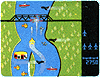 CATALOG DESCRIPTION (Fall/Winter 1983) CATALOG DESCRIPTION (Fall/Winter 1983)
The
enemy has positioned a series of bridges across the river to ensure a
supply line. Your orders are to destroy those bridges, and demolish
choppers, tankers, and jets that patrol along the waterway. As you
advance, the canyon narrows and the enemy gets smarter. Stay alert, the
enemy never sleeps. And any mistake you make could be your very last.
River Raid. Can you make it?
DEVELOPMENT
HISTORY
Carol Shaw originally designed and
programmed River Raid for the Atari 2600. Peter Kaminski
programmed this version for Intellivision. Activision later released
versions of River Raid for Atari 5200 and ColecoVision.
PLAYING
TIPS: From designer Carol Shaw and programmer
Peter Kaminski in the Pitfall! instruction
manual:
"The River of No Return holds many special challenges and dangers for
would-be River Raiders. You'll not only have to know your assault jet, but
you'll need to have a good idea of your basic flight plan before you
start.
"By knowing the river, pinpointing areas with the highest concentration
of enemy, and the most fuel depots, you'll have a much better chance of
surviving. We suggest you use the river banks and islands to your
advantage, since you can fly over them, while the helicopters and ships
can't.
"Fuel is also a critical factor. When you're far up the river, fuel is
scarce. Hence, flying to the next fuel depot should be your top priority.
Also, you'll find you can actually blow up a fuel depot right in the
middle of refueling. That way, you can gain points and refuel at the same
time.
"The really advanced player should practice flying through the trees.
Not only is it a lot of fun, but winging it through the forest might get
you out of a tight spot sometime."
FUN
FACT: Players who sent a photo to Activision
showing a score of 35,000 or more received an "Activision River
Raiders" emblem.
Robot Rubble
INTELLIVISION
CARTRIDGE [ACTIVISION UNRELEASED]
Design/Program: Steve
Montero
 GAME DESCRIPTION GAME DESCRIPTION
A robot is shooting at you
- lob a grenade to destroy it. Boom! But once it's gone, a tougher robot
takes its place!
DEVELOPMENT
HISTORY
Steve Montero developed this game at
Activision after programming the robot-themed Night
Stalker at Mattel Electronics.
The game was completed in late 1983, just as Activision decided to give
up on releasing new Intellivision titles.
FUN FACT:
Robot Rubble received its first known public display at the Classic
Gaming Expo in Las Vegas, August 1999. Expo attendees were able to
play the cartridge in the Intellivision Productions booth.
RocketBall
INTELLIVISION
CARTRIDGE [ACTIVISION UNFINISHED]
Produced by Cheshire
Engineering for Activision
Design/Program: Larry
Zwick
GAME
DESCRIPTION
A pinball game where you directly control the
ball with rocket thrusters.
DEVELOPMENT
HISTORY
RocketBall was in the early stages of
programming in late 1983 when Activision pulled the plug on Intellivision
development. The game continued in development as a Colecovision
title until it was cancelled outright in 1984 along with all other console
titles.
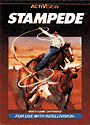 Stampede Stampede
INTELLIVISION
CARTRIDGE [ACTIVISION #M-001]
Design/Program: Bob
Whitehead
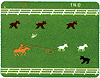 BROCHURE DESCRIPTION (1982) BROCHURE DESCRIPTION (1982)
Yahoo! Stampede
by Activision is bringing some kind of fun to your Intellivision. And some
kind of challenge! The object of this tough little video trail drive is to
lasso as many stampeding calves as possible. But hold on there, Pilgrim!
Those little "dogies" are right clever, and they'll do their darnedest to
outsmart you! So, ride hard, rope fast, and hold on to your hat! You're in
for the truest test of the wild, wild West!
DEVELOPMENT
HISTORY
Stampede was one of the first Activision
cartridges. The designer/programmer of the original Atari 2600 version
also programmed this Intellivision version.
PLAYING
TIPS: From designer Bob Whitehead in the
Stampede instruction manual:
"If you are really a savvy cowboy, you could probably play
Stampede till the cows come home. Strategy, patience and smart
herding and roping are what really count.
"First of all, keep in mind the particular sequences in which the
dogies appear. My advice is to establish a priority for roping the
stampeding herd.
"One strategy is to lasso the high-point dogies first, while keeping
the darker (low-point) ones herded in front of you.
"Herding is the most important part of the game. But remember, a dogie
that is repeatedly herded will get tired and become more difficult to
herd, because he won't run as far ahead on the screen.
"You'll notice that the dogies appear in rows. When you rope the last
one of a group of dark red Herefords...get set for some fast action,
'cause there's trouble ahead!"
FUN
FACT: Players who sent a photo to Activision
showing a score of 3,000 or more received an "Activision Trail
Drive" emblem.
INTELLIVISION
CARTRIDGE [ACTIVISION UNFINISHED]
Design/Program: John P.
Sohl
GAME
DESCRIPTION
Control a termite as it makes its way through
the walls and floors of a house wrecking havoc.
DEVELOPMENT
HISTORY
After the completion of B-17
Bomber, programmer John Sohl left Mattel Electronics
to work for Activision. He began this game for
Intellivision, but soon into development he was asked to do it
instead for the Commodore 64 computer, a machine Activision was
eager to support. John didn't finish the game for either platform before
leaving Activision.
INTELLIVISION
CARTRIDGE [ACTIVISION UNFINISHED]
Produced by Cheshire
Engineering for Activision
Design/Program: Shal
Farley
GAME
DESCRIPTION
Gather treasures while you scale the outer wall
of the castle.
DEVELOPMENT
HISTORY
Towerquest was in the early stages of
programming in late 1983 when Activision pulled the plug on Intellivision
development. The game continued in development as a Colecovision
title until it was cancelled outright in 1984 along with all other console
titles.
 Worm
Whomper Worm
Whomper
INTELLIVISION
CARTRIDGE [ACTIVISION #M-006]
Produced by Cheshire
Engineering for Activision
Design/Program: Tom
Loughry
 CATALOG DESCRIPTION (Fall/Winter
1983) CATALOG DESCRIPTION (Fall/Winter
1983)
Welcome to Felton Pinkerton's farm where corn
grows high at harvesting time. But, wait! Wave after wave of
horrible corn huskers are slithering, sliding, oozing toward your corn
crops. The corn must be saved! The worms must be whomped! Run to the shed,
grab your B-U-G pesticide and spray, Spray, SPRAY! Worm Whomper. Watch
what crops up!
DEVELOPMENT
HISTORY
Worm Whomper was an original
Intellivision game programmed at Cheshire
Engineering under contract to Activision.
PLAYING
TIPS: From designer Tom Loughry in the
Stampede instruction manual:
"As you will undoubtedly discover, protecting corn from invading bugs
can be a full-time chore. And even then, there will always be at least one
hungry bug that will survive the battle. Here are some pointers to help
you control the number of bugs and increase the productivity of your
crop.
"First of all, remember to spray the larger bugs first. They move the
fastest and take the most spray to destroy.
"Also, it is especially important to exterminate the moths as soon as
they appear. Although they don't actually destroy the corn themselves,
they do lay eggs that mature into hungry caterpillars. If moths have the
chance to lay their eggs close to the corn, the caterpillars will only
have a short distance to travel and feast.
"Another strategy is to save your plough balls for the later waves of
attack. All of the bugs will be moving much faster and that's when you'll
need the plough balls most.
"Finally, only defend those sections of the field that have the corn
growing on them. Don't even worry about the sections of the field that
have lost their corn, unless new stalks appear."
FUN
FACT: Players who sent a photo to Activision
showing a score of 75,000 or more received an "Activision Worm
Whompers" emblem.
|